Sunday, May 26, 2013
The dyadic approach to family therapy
Sunday, July 29, 2012
Jay Haley on marriage counselling - part 2
Monday, July 4, 2011
Marriage counselling and the rise of individualism.
I have talked before about society, psychology and the rise of individualism.
I made mention that psychological theory over the past 150 years has promoted individualism as the psychologically healthy state. Since the contemplations of Freud, psychology has been very influential in directing governments to structure societies such that individualism thrives. To my mind this has gone too far and the individualism which psychological theory promotes has indeed become a neurotic condition itself.
This is no where better demonstrated than in marriage. The divorce rate in Australia hovers around the 50% mark and of those who don’t get divorced probably half of them would if they were not under pressure from religion, family and friends, financial pressure and so forth.
Anthropological studies show that as societies evolved originally you had to live in groups. People found that if you lived in a group your chances of survival were much better. This is no better demonstrated than in the basic family unit. When a male and a female produce a child, that child had a much better chance of survival if the mother and father stayed together.
Thus the psychology of these people one could postulate, was about the survival of the group rather than a focus on the ‘psychological survival’ of the individual. In addition to just survival people would have also discovered that if you lived in groups you could achieve things and create a much better lifestyle than if one simply existed on their own.
As societies mature and become more affluent then the basic survival needs become more predictable and guaranteed. People feel more secure about their basic survival. When this happens instead of feeling relief along comes Freud and the navel gazing starts. People start focussing on their own individual psychology and happiness. This now has progressed over generations of psychologists to the point where individualism is seen as the zenith to be achieved.
This change of focus from survival of the group to the pursuit of individual happiness is reflected of course in how therapists ply their trade, especially in marriage counselling. This quote comes from a psychology text book on marriage counselling that is used in universities and training institutes for psychologists.
If there was ever a need for a collectivist mindset for survival it is between comrades in a theatre of war.
“The client who, out of his own feeling of need, seeks marriage counselling obviously has some dissatisfactions with that relationship. Some of his needs are not being met, or for some reason his life pattern is not providing adequate satisfaction.”
Yikes!!!
out of his own feeling of need
some dissatisfactions with that relationship
some of his needs are not being met
Sometimes in couples counselling clients say to me, “This relationship is not meeting my needs.”
When I hear this I get a sort of flummoxed look on my face, and think:
Hello! Marriage is not a happy pill. Marriage is not this thing that is to meant make you feel better about yourself.
No wonder the divorce rate is what it is.
Individualism riding roughshod over the collective. And we are training our psychologists and marriage counsellors to espouse that very view to the public by putting such ideas in the very text books we use to train them.
My counselling of married couples has changed somewhat over the years. I was trained on those textbooks as well. My approach besides exposing the underlying dynamics of the relationship would promote behavioural negotiation between the couple such that both parties can get their needs met more comprehensively.
Now I do more along the lines of the acceptance of the other person for who they are. Not so much about getting my needs directly met by the other, more about accepting the other for who he/she is.
However I feel this is a superficial response to the shift away from individualism to a more collective approach in marriage counselling. I feel a more basic change is needed but I am not too sure what that is at the moment. It needs to involve more of a change in the philosophical outlook on marriage that can be woven into the therapeutic process.
Graffiti
Saturday, July 2, 2011
Free Child communication in relationships
To understand such a diagram just think of a relationship which you like and enjoy and have a desire to be involved in. It is highly likely you have just identified a relationship in your life that has a significant amount of Free Child transactions between you and the other party.
In the honeymoon stage of a relationship these types of transactions occur quite often. Of course a solid relationship involves much more than just FC to FC transactions but my point here is that if a relationship does not have such communication then it will tend to fall on hard times. If there is very little then the ‘end is nigh’ often.
As a marriage counsellor one often sees couples who present with this type of communication problem, few FC transactions. This often occurs because the Free Child of both parties have ‘left the building’ as they say. The sensitive part of the personality has retreated into hiding for some reason.
Elvis leaving the building
In particular there are two common scenarios where this happens and presents a very real and difficult situation for the couple. This is often presented in marriage counselling and guess what they both involve sex and drugs! Why you may ask, because both sex and drugs often involve a degree of Free Child if not lots of Free Child.
Sex
Level of libido of a couple. If the couple have these combinations then sex is not going to be so much of a problem or at least it is a very good start for the couple not having difficulties in their sexual relationship. Both parties are either:
Low & low
Medium & medium
High & high
If they are either
Low & medium
Medium & high
then there is the potential for some degree of problem. If they are
Low & high
then there is a very real possibility of difficulties.
Why is this so? Because the Free Child is going to be affected. If the male has a high libido and the female has a low libido (which is usually the combination) then they have a significant problem that could contribute to destroying the relationship.
He is going to be asking for sexual contact often (or at least feel the desire to ask often). She is going to want much less. If she says yes when she wants to say no, it wont be long before her FC starts to retreat into the distance. She is having intimate physical sexual contact when she does not want it and the FC is not going to tolerate that for very long at all.
If she says no when she wants to say no (which will be often due to the different levels of libido) then one problem is solved but another is created. Her FC will feel satisfied but his wont be. His FC will feel ‘ripped off’ in some way. If this is occasional it does not matter all that much. But if it is happening most days what will happen after 5, 10 or 15 years? His FC is going to have disappeared in a similar fashion long ago.
A very real and difficult problem for a couple.
Cooperation in the relational
Alcohol and drugs
The most common scenario is the male likes a drink or a smoke and the wife finds him unpleasant or repugnant when he is intoxicated. The wife may say things like:
“He is embarrassing when he has been drinking”
“He snores loudly when he has been drinking”
“It is bad for the kids to see him like that”
“He may drive while intoxicated”
and so forth
So she asks, demands, threatens that he does not drink or use drugs (or significantly reduces the use). If he obliges and stops then her FC needs are met but this creates another problem. His FC will feel ‘ripped off’ in some way. If he continues to drink then his FC needs are meet but her FC will retreat into the distance.
After this occurring for 10 years what is likely to happen? Either one or both FC ego states have disappeared out of the relationship and probably do not even want to come back.
A very real and difficult problem for a couple.
In both these instances there are no winners. No matter which solution you take both parties loose in the long run.
It is best if the couple do not allow it to become such a large issue in the relationship. That’s easy for a bystander to say when not directly involved in it. Also most couples do not realise it is becoming a big issue until it gets there. And as I have said before most couples actually get into couples counselling 6 to 12 months late when the small issues have evolved into the very communication style of the couple. It is best to get to the problem when it is still relationship dystonic not when it has evolved into a relationship syntonic problem.
Graffiti
Friday, January 15, 2010
Libido and relationship problems
I did a bit of supervision the other day with a therapist who was asking about a couple she was working with.
This couple thought they had a sex problem with what the DSM calls the Hypoactive Sexual Desire Disorder. This is a significant absence of sexual desire that causes distress. This couple did it about once every couple of months which means statistically they were much less than average and they thought that is was a sign of a failing marriage. Both parties had quite low libidos.
So what is the average? For Australians it is:
18 - 24 years = 3.25 times per week
25 - 34 years = 2.55 times per week
35 - 44 years = 2.00 times per week
45+ years = 1.00 times per week
(OK! Enough with the jokes about doing it 0.25 times.)
I have always wondered how they get these statistics. Is it like a street side interview? There you are walking in a local shopping centre and you are approached by a heavily bespectacled woman, who’s hair is bound tightly back, she is in a white lab coat, carrying a clip board and she asks you how often do you do it?
And once the statistics are obtained how reliable are they? Lets face it guys may tend to exaggerate. When asked how often they do it they may huff and puff a bit, push their chest out and say they get ‘on the job’ everyday.
As we know when men get together and discuss their sexual exploits with the fairer sex they are prone to exaggeration. The general rule of thumb is take what they guy claims happened, divide it by 2 and you are probably some where near the truth. If he says he met a woman in bar last night, took her to his apartment and scored a home run that means he probably got to second base.
However the statistics don’t really mean anything when it comes to an individual couple. If they do it once every couple of months then they are very below the statistical average but what one is really looking for is how equal are their libidos. One is hoping for a relatively similar level of libido between then husband and wife. If their libidos are both low, both medium or both high then they do not have a sex problem at least in terms of desire.
If one has a low libido and one has a high libido then they have a significant relationship problem that can easily cause significant damage to their relationship.
Sex is usually a very Free Child to Free Child transaction. Sex that is good for a relationship is this even though people can have sex in other ego states. However if the desire for sexual activity is very different between husband and wife then they do have a relationship problem. If he has a high libido and she has a low libido then what happens when he requests sex.
If she says ‘yes’ when she wants to say ‘no’, then one problem is solved and another problem is created. His FC feels satisfied and her FC feels hurt. If this happens repetitively then her hurt FC will cause relationship difficulties and thus they both suffer.
If she say ‘no’ when she wants to say ‘no’ then one problem is solved and another problem is created. Her FC feels satisfied and his FC feels hurt. If this happens repetitively then his hurt FC will cause relationship difficulties and thus they both suffer.
When this happens sex can easily get entangled with power, punishment of the other party and so forth and by that time the relationship can start to get into very troubled waters.
So what is meant to happen according to the counselling textbooks? Well try before you buy may be a good idea. If a person is very sexually driven then it might be a good idea to seek a partner who is a little bit similar. Of course that is easier said then done once love gets involved.
As with so many relationship difficulties a bit of compromise on both sides can go along way. Satisfying sex does not have to involve intercourse, which is also a common solution if one party has herpes. So being a bit creative and coming up sexual activity that is reasonably acceptable to both parties such that both FCs can feel OK. Then the damage that could be caused to the relationship can be avoided.
Graffiti
Saturday, September 12, 2009
Parent - child couples therapy
Many years ago when I first completed my psychology degree I managed to meet up with another psychologist, who was a child psychologist. She was very experienced in the area and had a very well decked out play therapy room. I worked with her and the children in the play therapy for two years. I didn’t get paid but got the supervision and experience for those two years in exchange. That hands on training was invaluable and has served me very well over the years.
Since then I have seen children and their parents in my own therapy with them. When seeing a child on an individual basis for many years I would almost always want the parents to leave the room at some point often for most of the session. This allowed me to interact with the child without the parents there. Then commonly I would get the child to leave the room and then talk with the parents.
In recent years I have done that much less and now see the parent(s) with the child in the room all together. In essence I am doing a sort of couples therapy by getting them to interact with each other and then making my therapeutic interventions with them as they transact right in front of me.
Working at a transactional level.
When working with a couple, say hubby and the missus, at a transactional level I will keep in mind the transactional diagram that highlights the three main features of a functional relationship.
With a struggling couple I will see if they have a problem with their Parent ego state compatibility. That is, do they have big differences in their values and goals about life? This is a common reason for argumentative couples to enter therapy and the big three Parent values differences are - money, sex and children. Also do both parties display caring and kindness to the other party and do they engage in some Free Child to Free Child exchanges at times.
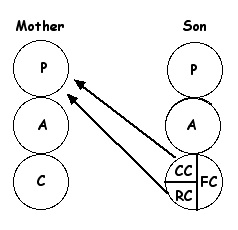
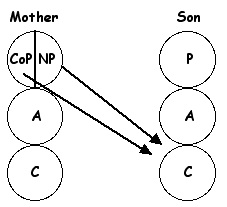
If I am doing couples therapy with a mother and a son, at a transactional level, what are the transactions that will define a functional relationship between those two people. What transactions will make for a workable relationship between them. I came up with the following three transactional diagrams.
First one is wanting to see some good Free Child to Free Child interaction between mother and son. This is essential in any relationship really but for the attachment process between mother and son to proceed and be maintained then this transaction is pivotal. With busy mothers and fathers these days this type of transacting often gets a low priority and can sometimes be seen as a bit of time wasting. However from a psychological point of view and in terms of building a functional and healthy parent-child couple it is crucial.
In some respects this is the most difficult of all transactions for a parent to do with a child because in one way it is antithetical to being a parent. Most parents don’t understand what this transaction actually means. If they are presented with this idea then they will usually say something like, “We can go to the movies together”, or “We can go camping together”. These are not Free Child to Free Child interactions, instead they are two people doing an activity together.
The FC to FC exchange is where a mother interacts with her son so that she personally gets something out of it. In this sense she is not being a parent because she is not doing it for the child's welfare or benefit but she is doing it for her own personal gain irrespective of the child. It is in essence an emotionally selfish act on the mother’s behalf. It is certainly not the act of her being a good parent in the usual sense of the word as she is using the child to get her own Free Child needs met.
When a mother suggests an activity that might be a Free Child transaction, one needs to ask a question. What’s in it for her? In the answer there must be some Free Child need of the mother that is getting satisfied. If there isn’t then it’s not an FC to FC transaction.
The advantage for the child is it sees mother getting her own Free Child needs met by interacting with the child. A most positive psychological experience for the child indeed.
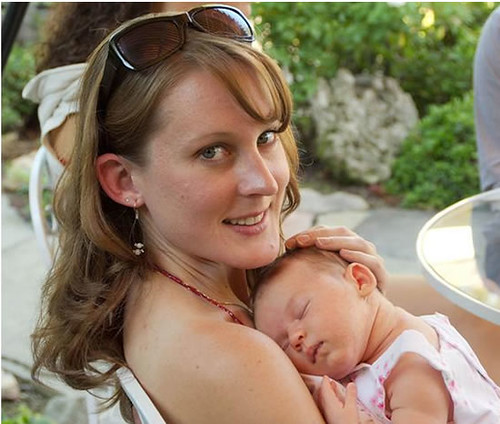
In this picture, you can see from the mother’s face and body language that she is getting something personally out of it. A FC need in her is being met by the interaction with the child.
Consider this. You are hanging out with someone and you can see how much they enjoy you and your company what does that mean for you and about you? If you have a young child, to whom mother is the most important person in the world, and it sees the same in her what is that child going to conclude about itself, her and the relationship?
The problem with Free Child is you can’t fake it. If she does not get a Free Child need met from her son then she can’t pretend to for the child’s well being. Hence we have one of those dilemmas of human nature. One of the healthiest things mother can do for a child is have such Free Child interactions, but if she does not feel that way then that can be quite psychologically destructive to the child and she can’t pretend. If she tries to, as can often happen, then the situation ends up worse.
What is it like to be friends with someone who tells you they like you when in fact they don’t? Over time you pick up the inconsistency, end up confused and worse off than if they had been straight with you in the beginning. Of course a young child will feel the same if mother tells it, it is liked and wanted when in fact it isn’t. However the psychological damage is much greater for the child than if it just happens to be between two adult friends.
Obviously there needs to be Adult to Adult communication as well. This of course is effected by the age of the child and how rudimentary their Adult ego state is. By the time the child is say 8 or 9 some serious Adult communication should be occurring. However even with quite young children one would be wanting to see mother asking the child how it likes its eggs cooked, or what colour shirt it likes to wear and so forth. In most parent-child coupling this is under done. The mother or father have many more opportunities to ask an Adult question of the child rather than simply making the Adult decision for the child.
In such a functional couple the mother would also be displaying a good amount of Nurturing Parent and Controlling Parent to the child. And on the other hand one is wanting to see a lack of such transactions from the child to the mother
Again this varies on the age of the child, but you are not wanting to see any significant degree of the child parenting the parent. For instance one sometimes hears of a mother who will discuss (seek counsel) her marital problems with her son or daughter.
If this happens from a young age then it can be particularly psychologically devastating for the child. It can lead to some quite serious personality maladjustment.
Finally one is wanting to see a good level of Conforming Child and Rebellious Child responses from the son to the mother. This is often good information to pass onto a mother or father as most often parents will see a RC response from a son as all bad. Very few parents will seek counselling because their child does not display enough Rebellious Child ego state. Very few parents will seek counselling because their child displays too much Conforming Child ego state.
In some families there can be one child who protests or fights the system loudly and the other child is quiet. Not uncommonly it is the quiet child who is more psychologically damaged. So in this mother and son couples counselling if the mother can see the son’s RC as a positive thing (at times) and then she is more able to respond to it in a productive way.
Again on the other hand one is wanting to see a lack of CC and RC responses from the mother to the son. One would not want to see this happening much at all as the parent is then behaving in a child like manner in her parenting. For instance one sometimes hears a mother say, “Johnny bit me so I bit him back”. A child like response indeed from mother.
Child-parent couples therapy
In marital couples therapy both adults can speak for them selves and say what they are wanting. With a child and parent obviously the child is far less articulate so in one sense the therapist becomes the advocate for the child. The therapist needs to be able to ‘hear’ what the child is wanting from the relationship and then state it to mother in a way that will be heard by her. The therapist becomes in one way the child’s Adult ego state in the couples therapy.
Graffiti