Showing posts with label early decision. Show all posts

Tuesday, February 19, 2013

Wednesday, December 19, 2012

Hierarchies - Core beliefs and script decisions


Cognitive behavioral therapy (CBT) and Transactional analysis (TA) have a number of commonalities. One obvious example being the similarity of what CBT calls automatic thoughts to the TA idea of early decisions. Automatic thoughts are faulty beliefs one develops in childhood, which result in problem behaviour and feelings later in adulthood. The faulty beliefs become ingrained patterns of thinking such that the person is often unaware they are influenced by them.

A recent significant contribution to the literature on CBT therapy and theory is presented by:

Judith S. Beck
2011. Cognitive Behaviour Therapy: Basics and Beyond. Second Edition. The Guilford Press: New York.

In this book she presents the idea of what is called a “hierarchy of cognition” (P36). This provides a hierarchical structure to core beliefs and automatic thoughts shown below, (P35)

Heirarchy of cognition Jpeg

The nature of core beliefs is described by Beck (2011) in the following:

“Core beliefs are the most fundamental level of belief; they are global, rigid, and overgeneralized. Automatic thoughts, the actual words or images that go through a person’s mind, are situation specific and may be considered the most superficial level of cognition. The following section describes the class of intermediate beliefs that exists between the two”. (P34)

“How do core beliefs and intermediate beliefs arise? People try to make sense of their environment from their early developmental stages. They need to organize their experience in a coherent way in order to function adaptively (Rosen, 1988). Their interactions with the world and other people, influenced by their genetic predisposition, lead to certain understandings: their beliefs, which may vary in their accuracy and functionality. Of particular significance to the cognitive behavior therapist is that dysfunctional beliefs can be unlearned, and more reality-based and functional new beliefs can be developed and strengthened through treatment”. (P35)

“People develop these beliefs from an early age, as children, with their genetic predisposition toward certain personality traits, interact with significant others, and encounter a series of situations”. (P228)

Kid
Put a child under significant stress and its natural temperament will begin to show. Is this flight, fight or freeze?


This sounds very similar to what the Goulding's presented in 1976 with their theory of early decisions. (Goulding & Goulding 1976. Injunctions, Decisions, and Redecisions. Transactional Analysis Journal, 6(1), 41 - 48.) As children develop they are from time to time confronted with distressing situations. When these happen the child will feel a need to make sense of them and this results in making early decisions which result in the injunctions which are automatic ways of thinking about self, others and the world. They proposed eleven injunctions in all:

Don’t exist
Don’t be you (sex you are)
Don’t be a child
Don’t grow up
Don’t make it (succeed)
Don’t
Don’t be close
Don’t belong
Don’t be well (sane)
Don’t think
Don’t feel

This in essence, is a list of automatic thoughts which the Goulding's observed occurred repetitively.

Hierarchy of cognition
What Beck (2011) provides is a hierarchical structure to core beliefs and automatic thoughts as was described above. This can be adapted to Transactional Analysis theory leading to a hierarchy of inborn temperament, life positions (core beliefs) and early decisions (Automatic thoughts). 

A similar model could be presented here

TA heirarchy of cognition Jpeg

To explain further, examples of this are provided here in relation to the suicide decision. The suicide decision is included in what the Goulding's called the Don’t exist injunction. This one injunction actually includes a subset of seven different types of suicide decisions as shown here

If you don’t change I will kill myself
If things get too bad I will kill myself
I will show you even if it kills me
I will get you to kill me
I will kill myself by accident
I will almost die (over and over) to get you to love me
I will kill myself to hurt you

When confronted with distressing circumstances some children will make a suicide decision similar to one of the above. The two examples presented below show how this can occur in a hierarchical structure.

Suicide decision heirarchy 1 Jpeg

Suicide decision heirarchy 2 Jpeg

We all have a natural temperament of some kind whether that be flight, fright or freeze. Then at a young age, probably preverbal we develop a basic belief (Core belief) about ourselves and others which in transactional analysis terms can be seen as the life positions. Sometimes this can also include an injunction that is especially influential. These in the past have been called core injunctions and the other injunctions are seen to be especially influenced by these. A good example of this can be the Don’t trust injunction which can become one of the core components of the personality.

After the core belief has been established the young child then makes a series of early decisions in times of particular distress and these are influenced by their temperament and the core beliefs. The two examples above show how the temperament in particular can influence the decisions made and then the final behavioral outcome.

In a similar way this hierarchical model can be used to demonstrate the development of physically violent behaviour as is shown below.

Homicidal decision heirarchy 1 Jpeg
When people make the suicide decision they decide that suicide is an option for them in times of high stress. The same applies for people who use physical violence as is found in domestic violence. The young child decides that to physically hit others is an option in times of high stress. If one has not made this decision then they will rarely use physical violence.

Graffiti

Wednesday, November 14, 2012

Early decisions and a child's thinking


In Transactional Analysis the A1 or Little Professor ego state is of considerable importance as it is a core component to the formation of our personality and script beliefs. In CBT terms this is how we get our thinking errors. It is the A1 that makes the early life script decisions that determine how we live the rest of our lives. 

C2 second order ego states

Unfortunately these decisions are usually made in the first 6 years of life and as will become apparent that means they are made with little or no A2 or fully formed thinking ability. They are made by the A1 in what are known as the stages of sensori motor egocentrism and pre-operational egocentrism.

This is some what disconcerting if not frightening because as will be demonstrated that thinking is quite illogical and distorted meaning the young child can make quite illogical and distorted decisions that are not reality based at all.

However this does explain how a child can make the suicide decision early in life which some people consider a bizarre thing to do. 

There are in fact seven suicide decisions a child can make:

If you don’t change I will kill myself
If things get too bad I will kill myself
I will show you even if it kills me
I will get you to kill me
I will kill myself by accident
I will almost die (over and over) to get you to love me
I will kill myself to hurt you


 In my book - Working with suicidal individuals - I state the following:

In the histories of suicidal individuals one finds parents can say many things which imply the suicidal message. For instance parents can say to the child:
“He’s our little accident”
“If it wasn’t for you I wouldn’t have had to marry your mother”
“We only stayed together for the kids”
“When you were born you tore your mother apart”
“You’re always hanging around me Jenny, why don’t you go and play on the freeway, Ha, ha, ha.”

Of course these only imply a possible suicide decision and as always it is up to the illogical thinking of the young child to conclude what it thinks about its own life. However if these kinds of things are said repetitively then it makes it more likely a child will made the suicide decision but is by no means a certainty.

Water boy

What follows is an explanation of A1 thinking in order to demonstrate how a child can make what is a seemingly bizarre decision about how it should live or not. (Some of this is adapted from:  Helman & Austin TAJ 1977.)

Egocentrism
Piaget noted this as a major cognitive limitation in a child’s thinking as it develops.

Egocentrism is the inability to differentiate one’s cognitive perspective from that of others. The child mistakenly believes that its thoughts and beliefs are also held by others around it.

Cognitive development proceeds from an egocentric perspective to a more objective perspective.  Objective thinking remains in the domain of the Adult (A2) ego state. In this type of thinking the person understands and acknowledges perspectives other than her own and they can be taken into account in any decision making process.

A mother who is arguing with her husband and then finds her daughter not in bed yet may hit the child angrily. A child who is only capable of A1 (Little Professor ego state) thinking cannot take into account other objective causal facts for the anger. The child may think. “There must be something wrong with me to make her so angry that she hits me.”

Happy

An older person with A2 thinking is able to understand there may be other causes of mother’s anger, such as just having had an argument with her husband. Thus it is less likely to make false conclusions about itself and mother.

Sensori motor egocentrism  (Birth to 2 years)
A1 thinking is beginning and the child cannot differentiate between her own physical and cognitive being, and that of others. The child does not comprehend there is a separate physical boundary between mother and itself and of course all its rudimentary thoughts are perceived as belonging to mother and self as they are perceived as one entity.

Pre-operational egocentrism  (2 to 7 years)
A1 thinking continues to predominate but the child is now aware there is a physical boundary between itself and mother. However cognitively she 
1. Does not understand that others have cognitive perspectives besides her, or
2. Does understand this but is incapable of taking them into consideration at the time of her decision making.


Two girls (Jenny and Jody) are running along, Jody trips and cuts her face badly. Jenny who a few hours earlier had been angry at Jody thinks either:
1. Her anger caused the accident. “People will get hurt if I am angry at them.” Jenny is incapable of seeing Jody as being separate from her.

2. Jenny is capable of seeing herself as separate from Jody thus knowing she did not physically cause the accident. However she did feel angry at Jody and still has the belief that the anger caused the accident.

Digit & beggar

Also in this stage the child has the view that everyone thinks like she does and the whole world shares her feelings and desires. This sense of oneness with the world leads her to assume that she is magically omnipotent - “The world is created for me and I can control it magically”.

Finally in the stage of pre-operational egocentrism we have pre-causal reasoning which to many mature adults appears disconcertingly illogical

Phenomenism
The child makes causal connections between events that just happen to occur together when there is no causal relationship.
The child sees a red object floating and says that it floats because it is red.
“When I was angry, mummy looked sad, I can control (am responsible for) mummy’s feelings”.

Finalism
Things happen because they are supposed to. There is always a reason for things occurring as they do
“Bad dreams happen to punish me because I am bad.”

Artificialism
There are two parts to this. First the child believes grownups are omnipotent, so the child feels defined by what they say. A child spills milk and mother says, “You always do these bad things to me”. Child then believes, “I am bad so things would be better if I was not here”.

Second, the child identifies with these omnipotent beings and believes she is omnipotent as well. This can result in grandiose thinking. Watching and angry father the child may think, “You could kill (obliterate) me. I can kill (obliterate) you.”

Animism
Child believes world and nature are alive and have consciousness like it does.
“A stone is alive because it moves”.
“It gets dark at night so I can go to sleep.”

Kids & gituar

Concrete operational egocentrism  (7 to 11 years)
Child becomes able to coordinate other people’s perspectives using both A1 & A2 processing. As she interacts with more people she learns there are others who have different perspectives and she becomes more able to coordinate these differing perspectives. This also results in a giving up on beliefs like father christmas and the tooth fairy due to peer input and increasing A2 abilities.

Graffiti

Friday, September 14, 2012

Suicide as a threat


In my book, Working with Suicidal Individuals, I note in the psychological sense that the suicidal person makes the early suicide decision usually before the age of 6 years. This can be seen as the truly suicidal person. The traditional literature on suicide tends to try and explain suicide as the consequence of things like depression, harsh economic times, as a consequence of mental illness and so forth. The big problem for this approach is it cannot explain why some depressed people are suicidal and others are not. There are some depressed people who are not suicidal at all. In my book I note research which shows that 50% of significantly depressed people are not suicidal at all. They don’t even consider the option of killing self because they are depressed. The concept of the suicide decision provides a clear explanation of how this could be so.

Having said that, people end their lives by their own hand for a number of different reasons and some have not made this early decision. However if they have made an early suicide decision then this person is a suicide risk. 

Cat leaping

I also make a distinction between short term suicide risk and long term suicide risk. The person who has made a suicide decision can be seen as a long term suicide risk. This means that at the moment there may not be at any imminent risk but in their psychology they have decided that suicide is a option for them under certain conditions. If such a person is identified, one needs to isolate what those conditions may be so one can be prepared should they develop. Also of course one engages in counselling like redecision therapy such that the early suicide decision can be rescinded or reduced in its potency.

Seven suicide decisions have been identified, these being:

If you don’t change I will kill myself
If things get too bad I will kill myself
I will show you even if it kills me
I will get you to kill me
I will kill myself by accident
I will almost die (over and over) to get you to love me
I will kill myself to hurt you

dog attack

In recent times I was working with a man who six months ago had separated from his wife. Prior to the separation she had threatened to kill herself if he left. He eventually did leave and two days latter she killed herself. She could have made one of a few decisions, such as:

If you don’t change I will kill myself
I will show you even if it kills me
I will kill myself to hurt you

He now was endeavoring to come to terms with this, make some sense of it such that he can go on and live his life. It is probably safe to say that to use the threat of suicide as a means of getting a person to behave a certain way is a very unprincipled thing to do. In one way it is the ultimate threat. To make another person feel responsible for their life.

Stingray woman

The bottom line in these situations is you cannot let yourself be blackmailed by such threats. If one does then such threats are likely to continue in the future. Also the bottom line is no one is responsible for the life or suicide of another person. This man knew this in his Adult ego state however he still had to live the rest of his life knowing that a woman he once loved and the mother of his children had killed herself because he left the marriage. I think it is safe to say that it is a difficult thing to come to terms with and not be effected by in a profound way.

Besides being a highly unprincipled thing to do it is probably a very regressed and child like way of acting. It is certainly angry, punishing behaviour and it works most of the time. Few people would not be effected by it even knowing in a logical way that they are not responsible for her choice to kill herself.

Graffiti


Thursday, September 6, 2012

Suicidality and war


“Female soldiers' suicide rate triples when at war”.
Recent research reported in the magazine USA TODAY (March 2011) Gregg Zoroya
(http://www.usatoday.com/) 

This research on US military found

1. When female soldiers deploy to Afghanistan and Iraq the suicide rate triples from 5/100,000 to 15/100,000.

2. When male soldiers deploy to Afghanistan and Iraq there is a 30% increase in the suicide rate from 15/100,000 to 21/100,000.

Jump woman

This could be seen to support the contention that going into a war zone can be used as a way to fulfil the suicide decision:

I will get you to kill me.

Obviously in a war zone there are plenty of people trying to kill you.

Or at least those who have made some kind of suicide decision

Those who are actually deployed may be a self selecting group to some extent. Those who have made this suicide decision will get themselves into the circumstances where they are more likely to be deployed than other non suicidal people in the military. One reason why the suicide rate increases is because the group has selected in more suicidal people.

Clown smoker

In the report the researches say the usual stuff. People deployed to such war zones are more stressed and so forth and this maybe the cause of such statistics. 

There is an alternate explanation. Stress has never made anyone suicidal. What stress can do is make an already suicidal person more likely to act on their self destructive urges. Thus a person who has made the suicide decision is more likely to end up in a war zone and when stressed is more likely to act on that decision. Hence the rate of suicide goes up.

Graffiti

Wednesday, June 27, 2012

Violence risk assessment


This comes from a violence risk assessment tool being developed. At the time of publication (2006) there was accumulating evidence that this is a valid measure and more research is being conducted. So as far as the empiricists are concerned it is looking good but is still not 100% ok from empirical research point of view. From the average guy in the street this is quite a good risk assessment tool with some significant scientific backing. It certainly is used a good deal in the literature
Like suicide risk questionnaires it uses the mathematical approach. You add up how many things the person has, the more they have the more risk there is of them acting violently. However as you would have found if you have read my book on suicide it pays to look at the various sections in more detail in order to get a more accurate assessment of risk. However disregarding that I make other comments on this assessment tool.

Ballet girls shooting

Historical
Previous violence
Young age at first violent incident
Relationship instability
Employment problems
Substance use problems
Major mental illness
Psychopathy
Early maladjustment
Personality disorder
Prior supervision failure
Clinical
Lack of insight
Negative attitudes
Active symptoms of major mental illness
Impulsivity
Unresponsive to treatment
Risk management
Plans lack feasibility
Exposure to destabilizers
Lack of personal thought
Noncompliance with medication attempts
Stress
Australian Psychological Society (2006)

social isolation

This originally came to my attention because I was writing about the difference between thoughts and behaviour. I have mentioned before that some clients can come to counselling expressing distress abut the thoughts they are having. I recall a woman who had a fear of sharp knives because when she saw them she had thoughts of stabbing her husband. My first statement is there is a very big difference between fantasy and behaviour. Or there may be some kind of sexual fantasy. Again I will say there is a big difference between fantasy and behaviour. What some find very erotic in fantasy would be completely non erotic in real life.
One should note in support of this the list composed above by hard core empiricists has no mention of violent thoughts or fantasies at all.

woman warrior

My thoughts on further aspects of the assessment tool to consider:
Substance use problems. People who are habitual users of marijuana and opiates like heroin are less likely to be violent compared to those who use stimulants like amphetamines, also alcohol with its strong disinhibiting effects and steroids.
On the section of previous violence I would also investigate any previous violence against self as well. It is plausible from a human psychology perspective that if a person is physically violent to self they have more ‘permission’ to be physically violent to others compared to the person who has no self directed physical violence.
Also I would add in previous exposure to physical violence as we know modeling can have an impact on human behaviour. The person as a child:
At the first level were they told about violence in the home or heard violence in the home.
At the second level did they see first hand violent acts in the home between others.
At the third level did they experience violent acts in the home to them self from another.
At the fourth level did they engage in violent acts towards others in the home.
The higher the level experienced the more permission they have to do physically violent acts on others as an adult.

girl & gun
The early decision to use violence as a solution to problems. By using such techniques as the bad day at black rock one can ascertain if the child made the early decision that violence is a viable way to solve problems. Some children make this decision and some do not. Those who do not are far less likely to use physical violence no matter how many of the criteria they meet in the above lists.
Graffiti

Thursday, June 9, 2011

Larissa - anger case study and results

I appreciate your posts on anger because it’s a huge problem issue for me. I’m not really sure how to answer these questions because my parents left when I was young (around two). They came to visit sometimes so I had parents, but they were more like guests and not really like parents. I think my parent ego state is based on my father’s parents (grandparents). So if there's anything I've said here that would help me deal with anger better, I'd love to hear it.

My Parent ego state and anger

When my grandfather was angry he would (Hit, withdraw and sulk, shout, swear, give a lecture, get sarcastic, eat, fight, get depressed and so on)

Say - nothing

Do – slam the door on the way out and leave for awhile

When my grandMother was angry she would:

Say – curse, call me bad names, scream, rant

Do – threaten to send me away, threaten to send my brothers away, threaten to hurt me, blame me for ruining her life

My Child ego state decisions about anger

When I was angry grandmother would

Say – I was ungrateful, call me names, scream at me

Do – whip me, blame me, hurt me

Feel – she hated me more than usual

When I saw grandmother or grandfather angry I would

Say - nothing

Do - hide

Feel - scared

What did your grandmother and grandfather say about expressing anger. (OK, not OK, good, bad, time & place, men & women, etc) I learned very young that it was not acceptable for me to be angry or even look angry in front of them…ever. I don't remember them ever saying anything about it.

As a teenager did you get rebellious and angry? If so how did you express it and how did the parent figures respond? As a teenager, I hated everything about living. I did a lot of drugs and drank. I was not good to myself and did dangerous things. Sometimes I ran away. I stayed away as much as possible. Sometimes my grandmother found my stash and she flushed it (or hell, maybe she really kept it for herself) and she'd tell me I was trash like my mother and a nutcase like my mother's father. Fortunately, I had a couple of really good teachers in high school who motivated me to stay out of trouble and encouraged me to escape home by finding work rather than laying drunk in the alleys. They saved my life.

Summation of early decisions = Anger is forbidden.

---------------

Results

This case study is a good example of how a person can acquire contradictory script messages about anger and its expression. As we can see Larissa made a Child ego state decision:

“Don’t feel anger”

or at least

Don’t express your anger”

This is held in the Child ego state. At the same time she would have introjected her grandmother’s anger expression into her Parent ego state. This is shown with the statements like:

When my grandMother was angry she would:

Say – curse, call me bad names, scream, rant

and

When I was angry grandmother would

Say – I was ungrateful, call me names, scream at me

Do – whip me, blame me, hurt me

Thus she has a strong model which shows that it is OK to feel angry and to express that anger in a forthright and demonstrative way. Thus Larissa has a contradiction in her personality in this way.

It is probably safe to say that the early decisions are more influential in the personality than the models, however at the same time the modelling of behaviour is recognised as a significant factor in personality development.

Logically there are 4 possibilities
1. Decision made with consistent modelling
2. Decision made with contradictory modelling
3. Decision made with no modelling
4. No decision made but with modelling of behaviour

Larrisa is possibility number 2 and this could lead to some outright
contradictory behaviour with anger at times. Or what is more likely is that the decision behaviour will by overt with the modelled behaviour being expressed in a more convert way. Indeed this may be the case with Larissa (however this is based on very minimal information)

She says:
As a teenager, I hated everything about living. I did a lot of drugs and drank. I was not good to myself and did dangerous things.


This could indicate that the permission to express anger has resulted in her expressing anger at herself. Which resulted in some self destructive behaviour. In relationships with others there maybe a suppression of the anger as the decision demands.

Graffiti

Thursday, April 22, 2010

Relational contact with the AC **


In Transactional Analysis terms it is the Adapted Child (AC) ego state where self destructive urges reside in the suicidal individual. The young child makes an early script decision that is known as the “Don’t exist” decision or the suicide decision. It is the AC part of the personality that encompasses that decision and thus subsequent suicidal urges are seen to come from there.


In the treatment and management of the suicidal one can give the client an opportunity to seek to clarify this ego state or part of their personality. One way to do this is to get the client to project that part of their personality out onto the environment. They can project it into an empty chair or they may draw it on a piece of paper thus allowing it to be projected out in that way.


This can be shown diagrammatically as:


The AC is projected out onto some kind of ‘screen’ allowing the client's and therapist’s Adult ego states to see it in a clearer form. Once done the client can see, understand and experience this aspect of the personality in more profound way than if it had never been ‘externalised’ before. However the point at hand is it also allows the therapist to understand it much better and begin to relate to that part specifically.


In my view one of the most important therapeutic undertakings with the suicidal client is precisely this. For the therapist to establish relational contact with the self destructive aspect of the client. When the client makes such a projection then such an activity is possible.


But why is it seen as such an important action? The answer to this question addresses the spheres of humans, relationships and attachments. The research is prolific and emphatic about the health promoting ramifications of human relationships and attachment. Humans are much more psychologically robust if they have substantive relationships (attachments) in their current lives. Indeed it is better to have attachments of a poor quality than no attachments at all. Humans need relational contact and they are healthier when they have it.


However it should be noted that what is being suggested here is different to the usual kind of relationship formation. It is different than two people meeting and over time forming a bond and attachment. The difference is that the therapist is addressing one specific aspect of the client’s personality rather than the person as a whole.


It seems safe to say that in normal relating this aspect of the personality would rarely be addressed or even recognised between the two people so a different dimension of relating is being discussed here. I do not know of any research on this specific type of relating. All I can do is make statements on what I have observed over the years of working like this in therapy. In addition I must say that I have rarely seen others set about to establish this type of relational contact with a client.


However my conclusion is that this type of relational contact is of considerable therapeutic value. A part of the client’s personality, the Adapted Child ego state, that rarely if ever gets directly addressed by another all of a sudden is not only being address but is being sought for relational contact. Some person all of a sudden is seeking it out for a relationship and attachment. Someone wants to get to know it and relate to it probably for the first time ever in its life. To treat it with respect and compassion again probably for the first time ever in its life.


Not uncommonly there is some initial resistance but that usually subsides quite quickly, after about three or four episodes of relational contact. Then there tends to be a dropping of its ‘harshness’ for the want of a better word. Initial contact from the therapist can be met with a response of glaring, subdued, abrupt, unfriendly, desolate and so forth. (I have just picked some words that try to explain the types of responses that can happen.) (It is similar to dealing with the lilith of a client)


It is a like a young child who has been ignored and maybe even derided for many years, all of a sudden is sought out in a compassionate way by a friendly other. It will feel most strange for the child, they wont trust it but they quickly discover that it feels nice. They may even be angry and hostile about being treated like that for such a long time. But if the other accepts the anger and hostility without abandoning it or hitting back angrily then the Child will start to find it is most appealing and then will start seeking it out by itself.


Graffiti
Friday, March 5, 2010

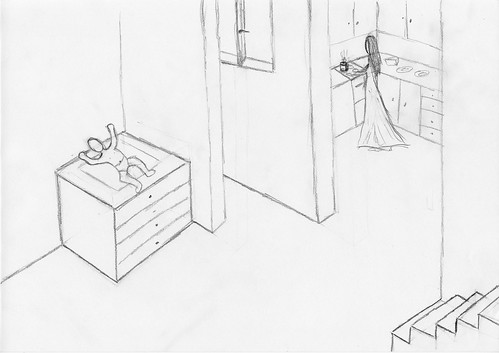
Life script analysis 4


For a larger version of this go to here. And click on "All sizes"

Story of drawing.

Mother is busy in the kitchen. The baby is waiting to be taken care of. It is crying, crying and crying. The baby is noisy and needy but it does not get picked up.


It’s not mother’s fault because she is simply busy. It’s the baby’s fault.


Father is working and mother is overloaded. She is just young and has duties that she never had to deal with before. The baby is just one extra duty on a long list. The baby is not 1 year old yet. It is not an emotional priority.


Why should this baby come first. Mother was overloaded and creates a sense of guilt in the child.


It thought, “I don’t deserve to get my needs met”. “I make mother’s life harder, it would be better if I was not here”.

------------------------

Comment on story

In terms of the fight, flight or freeze response to stress there is clearly no fight response in this case. It shows how the suicide decision can result in such circumstances as it did here. The baby does not view mother as treating it unfairly which would tend to be the fight response, “I am not being treated in the way that I should be, so its their fault” (anger).


Instead the response is to see mother as being over burdened with her domestic duties already and the baby is simply making mother’s life harder, thus it is the baby’s fault for it not being picked up. Thus it is not hard for the child to make the decision that things would be better for all concerned if it was not here. One could see this as the flight response and the feeling reaction is one of sadness and passive acceptance.


In being questioned on this scene the individual found it hard to say what her thoughts and feelings were. She stated that there were very few words and there was more feelings and noises instead. This gives the indication that the suicide decision in this case could be pre-verbal which also fits with the child being less than one year old.


If this is the case then one knows that the decisions made in this scene, including the suicide decision are going to be very resilient because they were made at such a young age before the child even had language. This implies that this individual will to some extent be potentially suicidal all her life. These very early decisions form the foundations of the personality and thus they are hard to alter through counselling compared to decisions made at older ages. The impact of the decisions can be changed but to expect them to be completely altered would be quite unusual and unrealistic. Thus there will always be a suicide decision there to some extent.


Of course a person of less than one year old can not recall such events as described and drawn here. For the purposes at hand it does not matter if it actually happened or not. These drawings and descriptions are really just visual, cognitive and kinaesthetic representations in the person’s mind, of the structure of their personality. This event describes part of the personality for instance in cognitive behavioural therapy terms, the thinking errors the person has. It does not matter if the event even occurred as it is the visual, cognitive and kinaesthetic representation the person currently holds in their mind which allows them to have consistent personality structures. It is what the person uses to actually have a personality.


I have always been surprised at how easily people will produce these early distressing scenes as well as being convinced of their authenticity. There is never a sense of people making up a story or telling a tale and so forth. Instead they produce a drawing of what they believed happened to them and as has been seen at times they can be quite elaborate and detailed. In addition the feelings and early decisions which were made as a result of the event can also be quite easily articulated.


Graffiti