Showing posts with label drug addiction. Show all posts

Saturday, January 11, 2014

Some therapeutic observations of the AA approach

Having worked with many who have embraced the AA approach as a way to stay clean and sober I find I am left with  some favorable comments to make about it.

Regardless of whether one agrees or not with the ideas of a higher power being responsible for one’s alcoholism or substance use I intend to just look at the some aspects of the AA approach irrespective of the underlying philosophy.

At the moment I am working with a number of people who are in the maintenance stage (of the stages of change model). They have been clean and sober for a number of years ranging from 2 to 10 years. With all of them the possibility of their relapse arises from time to time and represents a fear to them in varying degrees.  

In my view the way they have learnt to use the AA approach which makes it particularly suitable to the individual who is in the maintenance stage.

1. The self regulating aspect of the AA approach. As it is free and available everyday of the year one can regulate their own attendance at meetings. It can range from once every few months to a number of times daily.  When their maintenance is a bit shaky commonly they will increase their rate of attendance at meetings.

In most counselling situations this can not occur. It may get too expensive and most often the person has to make appointments with the counsellor such that they have to wait days if not weeks to meet. Even if it is free or they can afford it most counsellors don't really see the same client a number of times a day or every second day and so forth. In most counselling situations the ability for the person to self regulate contact is not permitted in the same way it is with AA.

2. The sponsor system. In my view another helpful aspect of AA that is used well by some of those at the maintenance stage to assist with their sobriety. The fact that they aren't trained counsellors and bound by lists of codes of conduct actually has a positive result in one way. It allows for a truly mentor type of relationship that one can only get with that type of informality. 

The formal therapeutic relationship between client and therapist actually creates quite a rigid structure in the relationship. In addition AA sponsors tend to have much more flexibility in their availability of contact. One of the reasons being that they have far less people ('clients') to be available to. This again allows for a person to self regulate their contact with the sponsor as they feel the need (at least to some degree). In the usual therapy relationship this self regulation by the client is far less flexible, again highlighting the rigidity one finds more in the usual therapeutic relationship.

The 12 step programme. At times those seeking to maintain sobriety can put themselves back onto the 12 step programme (self regulation again). With their sponsor they start again at step one and go through the programme. This seems to provide some with a more secure base. It gives them something to focus on and do that they see as protecting self. Also it is not a short programme taking, not days or weeks, but months. The individual places self on a long process which they see as part of their arsenal to fight addiction thus feeling protected in this sense. And as I said before it gives them something to focus on and do instead of using alcohol or drugs. 

Overall I have found some at least use the AA (or NA) approach in these ways which certainly helps them to remain clean and sober.

The other thing which must be noted is that AA is not therapy and is not attempting to be therapy. At least in the sense of helping people to resolve their childhood traumas, make redecisions, deconfuse and decontaminate and so forth. This raises an interesting issue. Is it possible to take some of these positive aspects of AA and weave them into a form of mentor relating? I purposely don’t use the word therapy because as soon as you do that you immediately impose all sorts of conditions and implications on the process and hence you loose the flexibility and as I said end up with quite a rigid relationship style.

Is it possible to find an in between ‘spot’. You are not therapist and client but you have two people relating who happen to be a therapist (which I will refer to as a mentor) and a clean drug user. The relationship would allow much more flexibility in how the ex user can contact the mentor and the mentor does not have to respond in a therapeutic manner.  Instead one could develop some kind of ‘step’ programme like AA has and the ex user and mentor could do that as well of course the relationship things which would firm up the person’s resolve not to use. Of course this could only be done with a very few ex users as the mentor would become over loaded. Also of course ti would not have to be kept to just drug and alcohol use problems.


Graffiti

Thursday, August 15, 2013

Gambling addiction vs drug addiction


The DSM-5 includes gambling addiction in the substance-related and addictive disorders along with the drug and alcohol addictions. Whilst this could be seen as a widely held belief that gambling should be included in such a category along with drugs and alcohol it does have some difficulties. 

Firstly, in my book I see the dependent drug user as having an attachment problem and this get transferred onto the drug and the person develops an attachment to the drug in the same way they develop an attachment to mother or father.

sumo

The person forms a symbiosis with the drug where the drug takes over the Parent (and to a lesser extent Adult) ego state functions.  Most obvious is the soothing effects of the Parent ego state. Dependent drug users are notoriously poor at self soothing. Drugs are very effective at soothing the drug user. 

In normal development a young child uses mother's Nurturing Parent ego state to soothe itself and then it learns to self soothe as it grows. Dependent drug users don't learn to do this and hence needs an outside 'thing' to do it for them and hence the drug fills that role.

In gambling there is no where near the same soothing effect. At the very best there may be a kind of mild soothing effect in the act of gambling for some but compared to the soothing that heroin can provide it is next to nothing. Hence the gambling addict does not form a symbiosis with the act of gambling in the same way a drug addict develops a symbiosis with the drug. Thus we see one very crucial difference between the gambling addict and the drug addict and why it could be seen as erroneous to include them in the same category as the DSM-5 does. 


I am not saying that a gambling addiction should not be seen as an addiction. What I am saying is that such an addiction is significantly psychologically different to an addiction to drugs or alcohol and it needs to be recognized as such. And as a result one cannot use the same treatment methods for a gambling addiction as they use for a drug addiction.

One could argue that a gambling addiction is really a passive behaviour. As we know the four passive behaviors are:

Doing nothing 
Over adaptation
Agitation
Violence or incapacitation

I am now going to contradict myself in what I said in gambling addition 1. In that post I said gamblers do not seek to form a symbiosis with another in the same way a drug addict does. The drug addict seeks to use another's Nurturing Parent ego state to self soothe whereas the gambling addict does not as gambling does not have the same soothing effect that drugs do.

Having said that, I now say that a gambling addiction could be seen as a passive behaviour and as we know the purpose of a person behaving in such a passive way is to form a symbiosis with another person. In my hypothesis the gambling addict has a very strong drive to do such a thing but in a different way to the drug addict.

A gambling addiction could be seen as a form of incapacitation. The person gets them self into a position where they are incapacitated and then some one else of some organization comes along and looks after them.

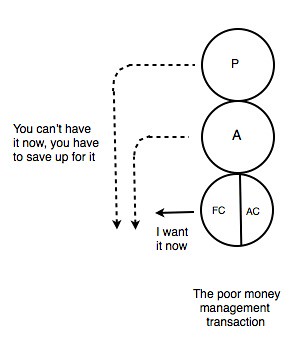
The gambling addict in essence does not manage money well. People who do not manage money well have an over active hedonistic Free Child that cannot be controlled by their Adult or Parent ego states.

As the transactional diagram shows the Parent and Adult are not strong enough to contain the Free Child want for the thing. I used this same diagram in my book to show how the recreational drug user functions. The recreational drug user can say to their own Free Child, “You have had enough now.” and the Free Child stops. The drug addict does not have that control over the Free Child. The same applies for the recreational gambler and the gambling addict. Indeed the same applies for any person who has high levels of credit card debt. They cannot control their Free Child want for the ‘thing’ now.

Poor money Jpeg

This leads to a state of incapacitation where the gambler ends up with high levels of debt. Satisfactory money management is so central to one existing in a society such that the gambler will eventually end up with some other person or some other organization managing their money for them and hence we have a symbiosis formed. The incapacitation leads to the symbiosis being formed. For example the man with a gambling problem may have all his pay put directly into his wife’s account and then she gives him a little bit of “pocket money” each day for him to spend.

The excessive drug user also can be childlike and irresponsible and have another person around them being the responsible one. However the consequences of the irresponsibility are not so dramatic. If the husband gets drunk, comes home and vomits on the floor in front of the angry wife then that is irresponsible behaviour. But a marital couple can live with that. If the man goes to the casino and looses $5,000 then a couple cannot live with that. If that happens over and over the consequences are far greater than if the husband comes home drunk over and over. The need to control the out of control gambling is far greater than the need to control the out of control drinking. Hence the need for a symbiosis is far greater for the gambler than for the drug user.

Masks

Thus the types of symbioses are different. What is required for the drug addict in a symbiosis is emotional soothing (Nurturing Parent ego state) whereas what is required for the gambler is practical life skills (Adult ego state).


Graffiti