Showing posts with label guilt. Show all posts

Saturday, December 22, 2012

Shame - What it is and working through


(Originally presented in
“Thoughts on Shame”. The Transactional Analyst. The quarterly magazine of the Institute of Transactional Analysis. Summer 2012, Vol 2 (3), Page 21 - 24.)

Introduction
I have always found shame somewhat of a perplexing emotion. It has some unique features that separates it from the rest of the emotions especially in how one deals with it therapeutically. This has lead me to research and study this emotion and hence the motivation behind this article. Writing on shame abounds in the literature including Wright, Gudjonsson and Young (2008), Gao, Wang and Qian (2010) and Wolf, Cohen and Insko (2010). In the transactional analysis literature an excellent statement on shame is made in a theme edition on shame in the Transactional Analysis Journal (April (1994)). Including articles by the likes of Erskine (1994) and English (1994).

Shame the emotion
In surveying the literature on shame one quickly comes across a debate about the nature of shame and what it actually involves. In this article the terms emotion, feelings and affect are used interchangeably. One commonly finds three concepts mentioned in relation to shame - internalized anger, guilt and shame itself. There are differing views on these such that one finds confusion in the literature about the nature of and definition of shame. For example Goss and Allan (2009) in their discussion of shame state, "It blends the different emotions of anger, anxiety and disgust, involves social comparison and can have different foci,…"(p303-304). Others have disagreed with this and attempted to distinguish the various emotions involved with shame including guilt and anger, (See: Gao, Wang and Qian (2010) and Wright, Gudjonsson and Young (2008)). This is also well summarised by Wolf, Cohen and Insko (2010) who state, "What are shame and guilt, and how do they differ? Within psychology, as well as everyday conversation, the terms shame and guilt are often used interchangeably. There is a general confusion about the distinctiveness of these emotions, possibly because of their many similarities."(p337-338)

As mentioned before anger and guilt are often mentioned as relating to shame or being part of shame. My own view is that each of these constitute three separate psychological processes. They are three separate entities. However they can and often do occur contemporaneously. This could then explain why some see guilt as being part of the shame experience or internal anger being defined as shame on other occasions. If one can define the three separate psychological processes this would clarify the nature of shame and its associated processes. Fortunately Transactional Analysis theory allows us to come up with quite clear statements about the distinct psychological processes involved in each of these three emotions.

Internalized anger
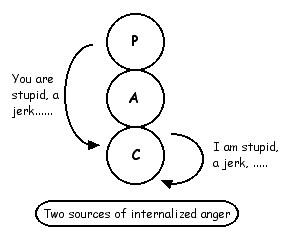
There are two ways in which internal anger can occur in ego state theory. See diagram 1.
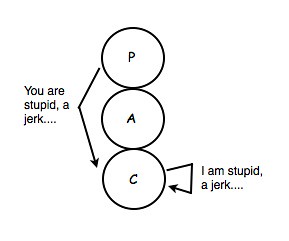
Diagram 1

Diagram 1

People can express anger at themselves from their Child ego state. When this occurs people will do negative internal self talk such as I am stupid, I was a geek talking to that girl and so on....

Anger can also be expressed from the Critical Parent ego state to the Child of the person. In this case the internal self talk starts with a “You” statement when an internal chastisement occurs. Examples may be “You were such a jerk talking to that boy”, “You can’t even get a simple report right”, “You stupid jerk” and so forth.

Guilt
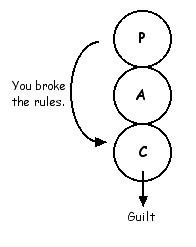
Guilt occurs when the person has a sense of breaking an internal rule which they have for themself. If a husband thinks the woman next door is hot and foxy but has a rule inside his Parent ego state which says, “Thou shalt not covet thy neighbour’s wife” then he can end up feeling guilt for having such thoughts.

Or a person may steal money from his brother and later feel guilt about it because he has the rule in his Parent that you don’t steal from your brother. People can feel guilty the next day after a night of drinking too much. Alcohol decommissions the Parent ego state and thus people behave in ways that they usually wouldn’t. The next day after the alcohol has worn off they feel guilty because the Parent ego state becomes active again. Diagram 2 shows the transactions.
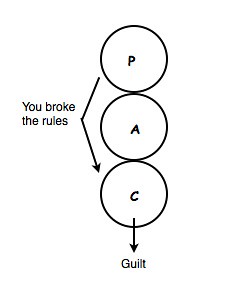
Diagram 2

Diagram 2

Shame
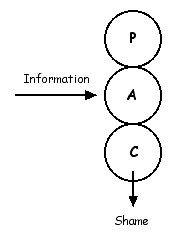
Finally we have shame which is a natural feeling reaction to particular environmental stimuli. Often, but by no means always, it is associated with sex, nudity or intimate bodily processes such as urinating or defecating. A prime example is the enuretic child who wets his bed at night. When the child wakes up and realizes he has wet the bed it is very easy for him to feel shame and he can go to extensive lengths to try and hide it. Indeed parents need to be very careful not engender a sense of shame in a child when he wets the bed. It needs to be dealt with carefully so as to avoid this. What is being suggested here is that shame is one of the innate feelings that all humans can experience. Others such as Adams (2008) and Kaufman (1992) have suggested the same. In this way shame is a natural Free Child reaction to certain events. Thus we have the shame transaction in diagram 3.
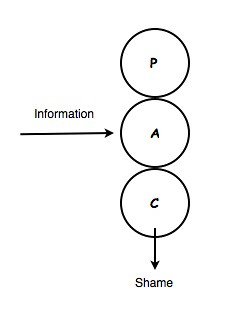
Diagram 3

Diagram 3
As you can see this differs from the guilt transaction in that there is no Parent to Child transaction before for emotion is experienced. This is consistent with Freud’s presentation on shame which is probably best summed up by Lynd (1958) who notes that guilt is usually more related to transgressions of clear moral codes and rules. No better example of this is found in religious texts which define what behaviors, thoughts and feelings are regarded as sinful. These are incorporated into the Parent ego state by the young child and when transgressed the individual most often will experience guilt. 

With shame the rules are much less codified and clear. Transgressions of them are more by tactlessness, errors in taste or bad luck. As a result the Parent ego state is much less involved in the process. Again the example of the enuretic child demonstrates this. Wetting the bed does not break a Parent ego state rule and generally would not be regarded as sinful. Instead it results from bad luck or factors outside the child’s control.

Presented here are three separate psychological processes – inward directed anger, guilt and shame. They can occur on their own or they can occur together. However if we see them as separate processes then we are afforded the opportunity to understand shame without the usual confusion of guilt and inward directed anger.

Exercise

Unique qualities of shame
What does a therapist do when a client presents with feelings of shame? One knows what to do when a client is angry. They feel the anger, they express the anger and when ready they drop the anger. When a client feels sad the therapist acknowledges the feeling, the client expresses the sadness with some kind of crying usually, one listens to the client, empathizes with them and is compassionate. Then the sadness is dealt with. 

The natural Free Child reaction to anger and sadness is a therapeutic one. There is a natural desire to talk about it, to have some kind of catharsis and release the emotion. This natural urge will result in the feeling being ‘worked through’ often with the support of a compassionate other. The feeling is naturally dealt with and resolved which of course is a desirable state of affairs and makes the therapy process clear.

However shame is different. When people feel shame there is a strong desire to withdraw or change the topic. The person wants to go into hiding in some way. Common bodily expressions when one experiences shame include a bowing of the head, an attempt to hide the face possibly with the hands, a blushing of the face, possible sweating, body bent over on itself and possibly a closing of the eyes. It’s like the person is endeavoring to make them self as small and invisible as possible and there is a strong drive to isolate self. This seems to be the natural Free Child reaction to shame. The problem with this, is it does not deal with it in the therapeutic sense unlike anger and sadness.

In essence it is an avoidant, ‘Lets try and forget about it’, approach. Therapeutically this does not resolve the difficult feelings. They need to be brought out into the open, experienced and then one can ‘get over it’. The Free Child reaction with shame is to hide and avoid. With most other feelings the Free Child reaction is a therapeutic one that will bring resolution of the painful event like expressing sad feelings when one’s cat dies. With shame the natural Free Child reaction will not bring resolution or closure to the event. Thus shame is somewhat unique in this way.

Polarities picture
Society likes a temperate woman


Working with shame in the therapeutic process
Paradoxically therapists are often working with shame even before being aware they are. For instance clients with bulimia or those who self harm often feel shame about their behaviour. As the natural response to shame is to hide often the client will not disclose such behaviour for some time. The goal here is to establish relational contact such that the client feels ready to disclose what they see as shameful behaviour but the therapist will only know that in retrospect. However when the client does finally disclose such feelings then one knows that successful relational contact with the client has been established. White (1998) discusses this in detail in his paper on transference and humanness of the psychotherapist. Such transferential and counter transferential contact is made when the therapist allows himself Free Child ego state contact with the client. This as he points out is surprisingly difficult to do but if done then the transference established will promote the client to expose their sense of shame to the therapist. Thus achieving one of the first crucial steps in working with shame in the therapeutic process.

The next step in this method of working with shame is to diagnose what is actually happening. As I said before shame, guilt and inward anger are often confused. The therapist needs to question the client to ascertain which of the three processes is occurring to see if the person is actually experiencing shame. Indeed one of the indicators that shame is present is the fact that the person has been reluctant to bring it up. Often there will be more than one process occurring concomitantly. Once established this can be explained to the client so they are aware of what is actually happening with their emotions in this way. Which of the three processes they are actually experiencing.

Shy Woman

If inward anger is diagnosed then of course the therapist deals with that appropriately as he does if guilt is indicated. The main problem emotion here is shame because as I mentioned before the natural Free Child reaction to shame is not a therapeutic one. 

The therapeutic response I have developed is really quite simple. As the natural response to shame is to go into hiding one invites the client to do the opposite. To come out of hiding and bring the behavior and feelings of shame into the relationship with the therapist. Basically they talk about it and the therapist responds in an empathetic way, also disclosing their Child reactions to the behaviour and feelings of shame. The therapist expresses his Free Child responses to what the client is saying. The goal is to normalize the shame response in the client.

Once the client has made such a disclosure the therapist can also raise the events at the appropriate times. One needs to be somewhat forthright in this way as this assists the normalizing process. The more it is brought up, talked about in an open way with no ‘shock and horror’ responses from the therapist the less shameful it becomes. The shame loses its potency over time. If the therapist always waits for the client to bring it up then the normalizing process can be very protracted. If mentioned only very occasionally there may be little if any normalizing occurring at all. 

Often the therapist needs to be proactive here and raise the shame producing events especially if the client never initiates talking about it. This is where clinical skill comes to the fore. One does not want to be always bringing it up but it does need to be raised from time to time. How often that is, depends on the client and the circumstances. If successfully managed then over time the shameful event becomes something that can be easily discussed with little or no shame reaction. At this point it can be said that the shame has been worked through.

Dont look

Conclusion
While the Free Child of the client has a natural drive to work through feelings like anger and sadness this is not the case with shame. Hence the therapist needs to intervene to halt the natural hiding away reaction by the client to their shame. The therapist brings out the shaming experiences at appropriate intervals, they are discussed and over time the potency of the shame significantly reduces such that open discussion can occur and there is little sense of shame in the client.


References
Adams, S.A. (2008) “Using transactional analysis and mental imagery to help shame-based identity adults make peace with their past.” ADULTSPAN Journal. 7, 1, 2-12

English, F. (1994) "Shame and social control revisited." Transactional Analysis Journal. 24, 2, 109-120.

Erskine, R.G. (1994) "Shame and self righteousness: Transactional analysis perspectives and clinical interventions." Transactional Analysis Journal. 24, 2, 86-102.

Gao, J. Wang A. and Qian, M. (2010) "Differentiating shame and guilt from a relational perspective: A cross cultural study." Social Behaviour and Personality. 38, 10, 1401-1408.

Goss, K. and Allan, S. (2009) "Shame, pride and eating disorders." Clinical Psychology and Psychotherapy. 16, 303-316.

Kaufman, G. (1992) Shame: The Power of Caring (3rd ed.). Rochester, VT: Schenkman Books.

Lynd, H.M. (1958) On Shame and the Search for Identity. London: Routledge & Kegan Paul.

Wolf, S.T., Cohen, T.R. and Insko, C.A. (2010) "Shame proneness and guilt proneness: Toward the further understanding of reactions to public and private transgressions." Self and Identity. 9, 337-362.

White, T. (1998) "Psychotherapy and the art of being human." Transactional Analysis Journal. 28, 4, 321-330.

Wright, K., Gudjonsson, G.H. and Young, S. (2008) "An investigation of the relationship between anger and offence-related shame and guilt." Psychology, Crime & Law. 14, 5, 415-423.

Thursday, June 7, 2012

Parenting and the use of adverse emotions


One of the most primary tasks of any parent is to facilitate the development of the Adapted Child ego state in their son or daughter. 
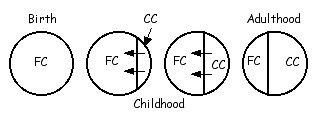
When a child is born it is all Free Child ego state. The parents must do something to the child such that the Adapted Child ego state increases and is used by the son or daughter when necessary. The child learns how to conform when necessary such that it can exist in a society. It learns how to behave appropriately when necessary. So over time the FC must decrease and the AC must increase. How much the AC must develop is a matter of debate. However that is not the topic of discussion here. What is to be discussed is how parents can go about doing that with their son or daughter.

ego state development
In this diagram CC has been used instead of AC

There are many ways it can be done and most are well known. The parents can use techniques like time out, consequences of behaviour or simply talking with the child such that it understands why it needs to conform in a particular situation.
There is another way to get a child to conform that is particularly effective. It involves using emotions. These are quite powerful at getting a child to behave in a way the parents want and hence they are used because they do work. There are three emotions that can be used in this way and they are fear, guilt and shame.
These are obviously painful emotions that people do not like feeling. As a result people, including children will modify their behaviour in order not too feel them. 

Towel person
If things go wrong here she could end up feeling shame.


Fear
Parents can use the fear of abandonment to get a child to conform.
“Unless you go to bed now mummy will get a policeman to come and take you away.” 
A child at a playground is not following mother’s directive to leave now to go home. Mother just starts to walk away in the direction of home. Most children will begin to squeal loudly in protest (and fear) at mother walking away. Eventually however most will succumb, leave the playground and follow mother. It works.
Guilt
“Mummy felt upset and really sad that you did not behave properly at nana's house.”
“You promised mummy you would clean up your room and you haven’t done it.”
The child feels guilt and it works so next time the child will behave in the way mother wants it to. 
Shame
“You should be ashamed of yourself for...”
The parent in some way derides or humiliates the child in front of its peers or siblings.
The child feels shame and it works so next time the child will behave in the way mother wants it to.


Kids & gituar
These two children are being compliant. How has that been achieved?


These are usually quite effective ways of getting a child to modify its behaviour to do what mother wants. They work. 
But there is a problem. They have unwanted long term side effects. The boy who has been threatened with abandonment by mother may grow up and have dysfunctional relationships with women because of it. 
He may constantly feel the threat of abandonment and become pathologically jealous. He may habitually pick women who do cheat on him and leave. 
He may forever remain single because he fears the abandonment that might one day happen.
If shaming is used as a way to get a son to conform then he will grow up and develop what is called a shame prone personality. In adulthood he will experience the feeling of shame more often than others do. Shame is a very unpleasant emotion and can have devastating consequences on the self esteem. Many a social phobia can have some kind of shame component as can happen with chronic shyness or a sense of just feeling worthless.
Graffiti


Friday, February 25, 2011

Shame - edit #4 (Part 1)

This post will develop over a couple of days

When one reads the literature on shame one finds a bit of confusion as to what shame is and is not. Or perhaps it is better to say that people have differing views on it. One commonly finds three things mentioned in relation to shame.

Internalised anger
Guilt &
Shame

These three things are often mentioned as relating to or being part of shame. My own view is that each of these constitute three separate psychological processes. They are three separate entities. However they can and often do occur contemporaneously.

woman pours paint

This would explain why some people may see guilt as being part of the shame experience or internal anger as defined as being shame on occasion. They can occur at the same time and often do. If one can define the three separate psychological processes this would clarify the nature of shame and its associated processes.

There are two ways in which internal anger can occur as shown in the diagram

Two types of internal anger

People can express anger at themselves from their Child ego state. When this occurs people will do negative internal self talk such as I am stupid, I was a geek talking to that girl and so on....

Anger can also be expressed from the Critical Parent ego state to the Child of the person. In this case the internal self talk does not start with a “I” statement but with a “You” statement when an internal ‘telling off’ occurs. Examples may be “You were such a jerk talking to that boy”, “You can’t even get a simple report right”, You stupid f**k” and so forth.

Guilt occurs when the person has a sense of breaking an internal rule which they have for them self. If a husband thinks the woman next door is hot and foxy but he has a rule inside his Parent ego state which says, “Thou shalt not covet thy neighbours wife” then he can end up feeling guilt for having such thoughts and feelings.

Amy winehouse..

Or a person may steal money from a brother and later feel guilt about it because he has the rule in his Parent that you don’t steal from your brother. People can feel guilty the next day after a night of drinking too much. Alcohol decommissions the Parent ego state and thus people behave in such ways that they usually wouldn’t. The next day after the alcohol has worn off they feel guilty because the Parent ego state becomes active again.

Guilt transaction

Finally we have shame which is a natural feeling reaction to a particular environmental stimuli. Often, but by no means always, it is associated with sex, nudity or intimate bodily processes such as urinating or defecating. A prime example is the enuretic child who wets his bed at night. When the child wakes up and realises he has wet the bed it is very easy for him to feel shame about that and he can go to extensive lengths to try and hide it. Indeed parents need to be very careful not engender a sense of shame in a child when he wets the bed. It needs to be dealt with very carefully so as to avoid this. Thus we have the shame transaction.

Shame transaction

As you can see this differs from the guilt transaction in that there is no Parent to Child transaction before for emotion is experienced. This is consistent with Freud’s presentations on shame which is probably best summed up by Lynd(1958) who notes that guilt is usually more related to transgressions of clear moral codes and rules. No better example of this is found in religious texts which define what behaviours, thoughts and feelings are regarded as sinful. These are incorporated into the Parent ego state by the young child and when transgressed the individual most often will expoerience guilt.

With shame the rules are much less codified and clear. Transgressions of them are more by tactlessness, errors in taste or bad luck. As a result the Parent ego state is much less involved in the process. Again the example of the enuretic child demonstrates this. Wetting the bed does not break a Parent ego state rule and generally would not be regarded as sinful. Instead it result from bad luck or factors outside the child’s control.

Lynd, H.M. (1958) On Shame and the Search for Identity. London: Routledge & Kegan Paul.


This indicates that there are three separate psychological processes - inward anger, guilt and shame. They can occur on their own or they can occur together. However if we see them as separate processes then the situation as to what shame is and is not can be kept more clear.


The separateness of these three psychological processes can be understood experientially as well. In therapy I may ask the client the following questions:

Recall a time when you felt guilty.
What happened and describe the feeling? Use a few words to describe what the experience of guilt feels like for you?

Recall a time when you felt shame.
What happened and describe the feeling? Use a few words to describe what the experience of shame feels like for you?

Recall a time when you felt angry at yourself.
What happened and describe the feeling? Use a few words to describe what the experience of self directed anger feels like for you?

Most people find this quite easy to do and report that the experience of shame and guilt are different which supports the contention that they involve discrete psychological operations.

If any one here wants to do this exercise I would be interested to hear your answers.

exposed self harmer


Shame and embarrassment

Under normal circumstances shame is not an emotion that is experienced all that often. The feelings chart shows there are various groups of feelings.

Feelings chart

I have purposely used the word “Family” because they are like that. There is a commonality amongst the feelings but they are also all different. Just like members in a family, they all have a basic commonality and they are also all different.

It is proposed that shame and embarrassment are like this. Embarrassment is a minor version of the full shame reaction and thus embarrassment is a much more common feeling for people to experience. It is safe to say that most people could relatively easily recite situations where they have felt embarrassed. Under normal circumstances there would be far less events to recall where the person felt shame.

They both come from the same emotion but vary in their impact. Whilst embarrassment is an unpleasant emotion to experience it does not have the devastating effect that shame can have. Charles Rycroft notes that shame is the cinderella of the destructive emotions. The experience of shame tears at the core of who we are. It effects us at a deep level and the understanding of who we are.

Tiger chaser

With guilt people can have the experience of,

“I am bad for doing that thing”

whereas with shame the person is more likely to end up with the feeling of,

“I am bad”
Whilst the shame will be connected to a certain event occurring the resultant comprehension of it is more about me as a person rather than about something I have done. Shame has far more destructive power than most other emotions.

As stated above under normal circumstances shame is infrequently experienced. It tends to only be experienced in relation to quite unusual circumstances, where as embarrassment is more frequently experienced in reaction to a wider range of events. There is however an exception to this.

sheep & kid
Will he feel embarrassed about ending up like this? Lots of people are watching!


Parents quickly learn that emotions are a effective way to get children to conform.

They can use guilt.

“Mummy will feel sad and hurt if you don’t eat up all your food”.

They can use fear by threatening abandonment.

“Unless you have your bath now mummy will get a policeman to come and take you away”.

These emotions cause pain in the child and thus the child will tend to behave in order to avoid the painful experience. The same applies for shame which can be a very unpleasant emotion to experience. Thus parents can say things like,

“You should be ashamed of yourself for.....”

It works in getting a child to behave in a certain way but it is also particularly destructive in the ways described above. I would strongly advise parents not to employ this kind of child rearing practice.

dog attack
This will get people to conform, but at what long term psychological cost?

If you are working with a client who reports this kind of parenting in their childhood then you know the person may be damaged psychologically at quite a deep level. Also they will tend to report the experience of shame in the present more than average. They will tend to react to events with shame whereas others would tend to only experience embarrassment. This of course just amplifies the problem.

Rycroft, C.
1971. Reich. Fontana: Great Britain

The discussion about using shame as a parenting technique provides insight into the difference between neurotic shame and Here and Now (H&N) or reality based shame.

AC vs FC shame

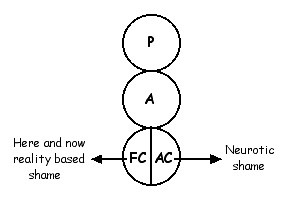
This figure shows the two different types of shame are functions of two different parts of the personality. Reality based shame is a function of the Free Child aspect of the personality and the Adapted Child ego state is where neurotic shame would result from.

This proposal rests on the assumption that shame can be a normal and natural human emotion. An assumption that gets plenty of support. Firstly Freud (1942) notes that shame is “,,, organically predetermined...”(p.46). Then English (1994) discusses the topic in some depth. As she notes it would be impossible to instil shame in a child who did not already have the organic receptors for it. The ability to feel shame can be seen to have some evolutionary advantages as well.

English reports that Charles Darwin suggested that shame had certain evolutionary advantages. Shame is often around nudity and sexual matters and that covering up the genitals afforded more protection of them which also increased the likelihood of the propagation of the species. The expression of shame often involves blushing and a desire to hide which corresponds to the feeling of being dangerously exposed.

Borat Free Child
Why only cover up those parts of the body?


English, F. (1994) ‘Shame and Social Control Revisited.’ Transactional Analysis Journal. 24, 2, 109 - 120.

Freud, S. (1942) Three Contributions to the Theory of Sex. London: Imago.


As a result humans are so constructed that should a particular set of circumstances arise they will naturally feel shame. To make the assessment of reality based shame versus neurotic shame one needs to judge the appropriateness of the circumstances that have lead to the shame reaction.

Sometimes this is clear but at other times it is harder to assess. As said before shame is often, but by no means always, associated with nudity, sex or intimate physical and psychological factors. Below are some instances where many would feel shame as an appropriate H&N reaction.

The child who wets its bed or soils itself.
A woman discovers her ex-partner has placed intimate nude photographs of her on the internet for all to see.
A man is publicly exposed as an adulterer in his church group.
A man publicly jokes about his wife’s vaginismus.
A woman pokes fun at her husband about his baldness which she knows he is very sensitive about.

Lady rings on eyes

If a person reports feeling shame in such situations these could be diagnosed as Free Child shame reactions.

Some times the circumstances are less clear.
A teenager gets an F for his maths test.
A lecturer trips on steps as he walks up onto the stage to give a lecture.
Is it appropriate to feel shame in these examples, is harder to judge.

Many people with a social phobia report shame and embarrassment that is neurotic in nature. They feel as they walk into a social gathering that everybody is looking at them, they look awkward and odd such that they experience shame. Or as they talk they think they are blushing and saying stupid things and feel shame as a result.

These are likely to be Adapted Child ego state responses of shame. One reason why these occur can be due to the parenting styles as described above. If the parents have used shame as a method of punishment and said things like, “You should be ashamed of your self for...” the person is primed to have shame reactions as an adult. As a result they will have reactions of shame when most others would not.

Japanese lady

This leaves us at the next juncture of what does one do when they feel shame? Thus the distinction between neurotic and reality based shame assumes some importance.


Graffiti