Wednesday, December 12, 2012
Aspects of drug use ambivalence
Thursday, April 28, 2011
Final fantasy 3
Dream and daydream (fantasy)
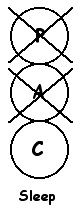
In terms of personality structure night dreams and day dreams (fantasy) are somewhat similar. In dreams (night) the Parent and Adult ego states are almost completely decommissioned and cease to influence the personality at all.

With the Parent and Adult decommissioned the conscious is gone and the person is left only with their unconscious. This is why Freud used dream interpretation, when asleep the unconscious can gain expression free from any conscious control. Thus it provided an important way of understanding the unconscious.
In daydreams or fantasy the Parent and Adult are also decommissioned but to a lesser extent than when asleep. Thus it also affords an opportunity to understand the unconscious as well.
Obviously in a daydream the content is under conscious control unlike a night time dream, at least initially. Sometimes daydreams may start at one point and end up at an unexpected point for the dreamer. Also daydreams are a 100% personal event. No one will ever know about them unless they are told of the content. Whilst a group of people have some Parent ego state restrictions about fantasy content as was described in Final fantasy 2, for most the content is completely uninhibited. Anything can be fantasised and thus the unconscious desires, conflicts and so forth are given a wide range of expression. Like they are in night time dreams. There are very few other circumstances where the unconscious is given such freedom of expression as in fantasy and dreaming.
One advantage that fantasy interpretation has over dream interpretation is that it tends to be more literal. As there is some level of conscious control the images created in daydreams they are more obviously related to the psychological forces behind them. In dreams the images created as less obviously related to the psychological content behind them.
Types of day dreams (Temporary)
Self soothing
Wish fulfilment
Self aggrandisement
Defence mechanism
Reflection of current issues - conflict, sexual, aggressive, etc.
Sometimes day dreams can serve a number of these reasons at once.

Zena warrior princess
An example is provided by Kahless who says:
“My day dreams generally revolve around me performing a heroic but fatal deed.
I used to day-dream being a secret agent, or a fireman, or Lara Croft.
These days I am just me. This very morning I day-dreamed that I was at work, in a meeting and armed gun-men stormed in. They said they would release everyone if someone volunteered to play russian roulette. I volunteered. I looked them in the eye and said "come on then fuckers."
I fantasise aka day-dream, a lot.
In real life, people around me say I am courageous. I think I am and I am not. Sometimes I like to just plain put my head in the sand.
Maybe this links into my blog name and my avatar.
Kahless - a Klingon warrior
and a lion who maybe from the Wizard of Oz.” (end quote)
Watch this space
Graffiti
Friday, July 30, 2010
Carl Rogers and health
Harriet states: I also thought of Carl Rogers when I read this. What did he say? Something like every person's goal should be to be the person who they truly are.
Carl said a lot of things Harriet. In his original writing there is a lot on transference that includes taped dialogue from sessions he did with clients. They are very interesting to read as one gets a bit of insight into how he worked as a therapist. However most of this is forgotten and he is most widely known for his clarification of the three essential features of the therapist in relationship with the client.
Genuiness - Therapist is aware of his own feelings, thoughts and attitudes and these are not concealed from the client.
Empathy - Understanding the client’s experience from the client’s point of view.
Unconditional positive regard - Conveying to the client that they are worthwhile humans no matter what they do.

Home wrecker
This has had a profound effect on the practice of psychotherapy which is why he is regarded as one of the greats of the field. As usual it is the simplicity that makes for it being more profound.
It seems reasonable to conclude that he was not the first to think this up. People would have known long before Rogers time that being genuine and empathetic was good for a relationship especially a helping relationship and I am sure teachers long before Rogers would have told their students such a thing. However he articulated it well and was in the right place at the right time and thus he became known as he is.
However this does raise an interesting and debated point of view. His approach and philosophy rests on the assumption that, “Love will cure it”. That is if you place a person into an environment or relationship that is genuine, empathetic and has unconditional positive regard they will naturally get better.

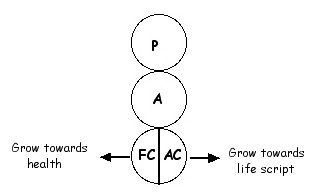
If you place a person in a nurturing and positive environment then their natural urge to grow and develop will be activated and the person will grow and develop towards psychological health. In transactional analysis terms it would be said that the Free Child aspect of the personality is energised or cathected and this is where the desire to grow towards health results from.

There is another school of thought that says, “Love alone is not enough for cure”. Without a doubt a loving, positive environment is good for one’s psychological health, but there is also an Adapted Child part of the personality that propels the person to ill health (or to their life script).
This side of the debate say that pure positivity is not enough to counter the drive to psychological ill health. At some point in the treatment you have to deal with this and that means doing something with the client that is experienced as painful in some way. That may be a confrontation of some kind that the client does not want to hear, getting the client to face their mother or father who abused them and so forth.
Some form of painful treatment is applied and this raises much heated debate. There are a group who say a client should never be subjected to painful treatment techniques with a common example being ECT or some form of aversion therapy like happened in the movie Clockwork Orange. You could argue that Carl Rogers would have been of the view that you do not apply painful treatments.

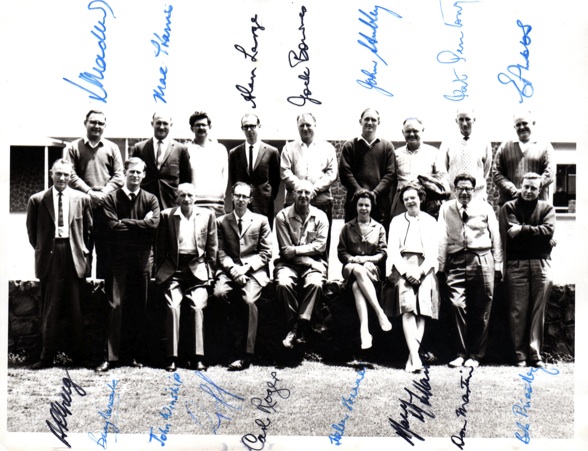
Carl Rogers workshop (1965)
My father back row third from right
Carl Rogers front and centre.
Of course there are much less dramatic painful techniques than ECT or aversion therapy and I certainly use some of them myself. For instance some two chair techniques could be placed in this category and this fits with my personal philosophy. Unconditional positive regard, empathy and genuiness as most useful in allowing the client to grow towards health but they are not enough in most instances. The AC is an active part of the personality that ‘love’ alone cannot over ride. It needs at some point to be dealt with directly and that usually involves some kind of angst for the client. Keep it to a minimum for sure but it is needed at times.
Graffiti