KYLady says
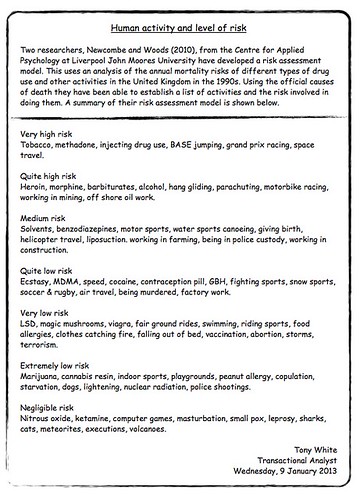
“This is an interesting post - the topic relates indirectly to my research. Behavior is influenced more by perceived risk as compared to actual (statistical) risk. Perceived risk can change day to day depending on events and conditions one is aware of. When risk becomes normal, people become more carefree about hazards they are exposed to. Normalized risk is a huge factor contributing to accidents on the job.” (end quote)
This is an interesting comment and adds to the concept of the normally adjusted suicidal person. It could be argued that a person can change actual risk to perceived risk simply by making the awareness of the danger unconscious. When that is the case the person will continue to act on their primary suicidal motivations even if they are not consciously aware of the behaviour they are using to express those motivations. Indeed this would put them at even greater risk of a completed suicide because of that lack of awareness.

If there is something that is clearly dangerous such as driving cars at very high speed and the person does not perceive it as dangerous they could have done that by making that information unconscious. They have employed some kind of defence mechanism to rationalize the risk away. This then makes the person at more risk of a completed “suicide” in the way I am talking about suicide in part 1.
A good example of this can be found in a case study in my book - Working with drug and alcohol users.
“A 37 year old woman recalls her thinking and feeling as she ignored harm minimization information.
"Never in wildest dreams did I EVER IMAGINE that I would share needles. Some of the details around these circumstances I can’t recall. I spose it was so traumatic, having a medical background and a deep moral code around sharing fits it still seems unbelievable.
I would ask the people who had used the fit before me if they had HIV or hepatitis and I chose to believe their response of no. Truth has no place in this world, if it shows up then is gets distorted, ignored or disproven because truth and drugs cannot be in the same room. The thought of not being able to get the drugs into me as quickly as possible especially when watching the others getting relief from their pain was something I could not take. This anxiety...fear far outweighs the fear for my own health and life. It was like trying to resist the sound of a newborn baby crying when you’re breast feeding.
I would disassociate from reality, time and space changed. I would wash the fit out with alcohol or bleech the whole time repeating a mantra of 'Please God, please God'. I would think who cares anyway, you’re fucked and life is fucked and you’re all fucked. Self loathing and the fear of not getting that rush would fuel me on.
Then the ritual of mixing up would begin and my mind would start bargaining “you’re not really going to do it” “you’ll stop before you whack it” but there is no stopping by this stage, you’re like a robot and this thing has you in its grasp. I would cry as I found a vein, wishing I could stop, jacking it back, holding in the sobs so I didn’t shake too much, then pushing it down the relief flooding over like a lover holding you in their arms no more 'aghhh!!' and once again I’m cleaver and funny, all worries dissolve, I am a sex goddess and philosopher, brave and complete, all fears drift away". (end quote)
This shows a number of defence mechanisms being used to make the danger unconscious. Or making the actual risk and perceived risk different.
Another quote from my book:
“1. Firstly she describes how she would ask others if they were carrying the HIV or hepatitis C virus. She knew the answer of ‘no’ could be considered quite unreliable. To proceed she must have used some mechanism like repression or denial to push the knowledge of unreliability out of her conscious.
2. Next she describes how she could dissociate which would allow her to decommission her Adult ego state temporarily which would allow her to proceed. This may have also assisted her discounting the unreliability of her peers reporting they were virus free.
3. Then she talks about repeating the mantra, “Please God please God”. This could be the defense mechanism of magical thinking where the Child ego state can feel safer because she has ‘prayed’ and this will some how magically make her safe.
4. Next she moves to an angry position with her comment, “I would think who cares anyway, you’re fucked and life is fucked and you’re all fucked.” This may be the defense of minimization. If she can convince herself that everything is bad then one little bit more of badness is not going to make any difference. It would allow her to minimize the importance of sharing needles.
5. Finally she talks about how her mind would start bargaining which may be a kind of rationalization. Convincing herself that her preparations for drug taking were not wrong because she will pull out at the last minute.” (end quote)

These five ways shows how she can perceive the risk to be less as the awareness of the danger becomes unconscious and she can continue to engage in the ‘suicidal’ behaviour which expresses one of the motivations in her personality.
Generally speaking people will not consistently behave in a particular way unless it reflects a basic part of their psyche or some primary motivation they have. They just will not do it for any length of time. If a person is not suicidal they will not do high risk behaviour even if the level of risk is unconscious. The unconscious will be reflected in repetitive behaviour just as the conscious will be.
Graffiti