Showing posts with label envy. Show all posts

Sunday, June 17, 2012

The psychology of the beautiful woman - Part 3


In the first two posts of this theme I have mainly talked about the woman's’ relationship with men. Of course she also has to relate to the other 50% of the worlds population - all the other females. What are some of the psychological consequences of the very physically attractive woman doing this?
It seems that she is in the same position as any exceptional woman. Those who may have exceptional ability in sport or academically or perhaps special musical ability. How does this effect the relationship with her same sexed peers.
My answer to this by and large depends on how she handles it. There will be a group of peers who develop quite envious feelings about her specialness with men. However this would usually not be a large group. I have talked previously about envy here.

Hand stand

I think it is safe to say that most women will not feel envious to any significant degree and indeed they will feel happy for the attractive woman. I have done a bit of ad hoc research on this. On Facebook one can look at many peoples photographs, sometimes the owner of the Facebook will be a very attractive female. I came across one the other day of a woman in her early twenties who is very physically attractive and she had the usual collection of photographs. Some of the pictures were her all dressed up, socializing somewhere highlighted all her attractive physical features. I have cited the 27 comments that followed her picture and have indicated which were made by females (14) and which were made by males (13).
amazing - m
your body is insane - f
outfit = niice ahhaha - f
insane body and looks :) - m
stunning! - f
fukn hell - m
holy shit. that is all - m
electraaa :) - m
:) you look soo good - m
fuck me - f
you are so hot - f
your amazingg! - f
Such good tattoos and costumee - f
amazing - f
O amazing - m
best compliment when people say we look alike! your gorgeouss - f
 JESUS FUKING WOWWWW - m
wow.. you are amazing - f
100% pornstar - m
your body ! - f
OH MY GOD! - m
i hate it - f
amazing - f
yummmy - m
JESUS! - f
pornstar? - m
Small tan - m

Two women


Only one comment is adversarial. Of course there may be others who have felt envious and simply not commented but it is interesting to see that just as many females have commented as males and the female comments are kind and nice and complimentary. 
This was typical of other pictures she had and it shows that females are prepared to make public comment, enjoy her good looks and wish her well. This is what I would have expected to happen which is nice to know.
However it seems reasonable to assume that a lot of it depends on how she handles her beauty. Does she shove it in others faces, does she develop a sense of superiority because of it, does she let others know how much more beautiful she is than them.  If she does not do such things then most people are going to like her and not be put off by her and her appearance. If she treats others with respect then they will do the same back no matter what she looks like. There is nothing amazingly remarkable in such a proposal. Really it is a bit of a non issue for the same sexed peers of the beautiful woman if she handles it well.


Jealousy


From a parenting point of view it can be a difficult scenario when she reaches early adolescence and discovers what her physical appearance can get her. In particular the effect it can have on males. The parents need to be sensitive to the view of males that she is beginning to develop. There are a group of males she will be able to exploit and exploit a lot including direct financial exploitation. Of course a parent is not wanting this to happen.


I recall many years ago a small group of girls in my social circle who used to boast they could go out on a Saturday night with no money and come home fed and inebriated. Nobody likes a user and I made sure I kept them at a safe distance.

Finally we have the very difficult parenting situation where one daughter is very attractive (or has some other form of exceptional ability) and the other daughters are not. This can sometimes result in the cinderella life script. The parents downplay the attractiveness of the one daughter so the others don’t feel so bad or not as good as their beautiful sister. 
Alternatively the parents may repeatedly highlight the one daughters beauty and not mention the other daughters and this can have a detrimental effect on the sisters. A difficult parenting situation indeed that needs to be handled with caution.
Graffiti

Friday, April 1, 2011

Envy (Compare and contrast). Edit #2 (part 2)

Websters definition of envy:

“Painful or resentful awareness of an advantage enjoyed by another joined with a desire to possess the same advantage.”

Two people sit side by side listening and watching a friend play the piano in a very masterful and talented way.

The first person feels the beauty of the music and has admiration for the obvious talent of the pianist.

The second person is consumed with envy. She thinks it is not fair her friend is so talented, that she has a big nose and she is not so good at tennis.

Hand stands
Talent

The second person has done compare and contrast and the first person has not. They both are in the same situation, one person has compared and contrasted the pianist to self and one has not.

The first person does not have the desire to possess the same advantage and the second person does. The first person may not even be aware the pianist has an advantage whilst the second person is acutely aware of the advantage.

Why is this so?

and

Perhaps one can only feel envy if they use the psychological mechanism of compare and contrast first?

Home wrecker
Home wrecker or talented actress


If this is so then the treatment of pathological envy could be dealt with by disrupting the need to compare and contrast and disrupting the persons ability to engage in the process of compare and contrast.

------------------------------


Why compare and contrast

It seems there may be a number of possible scenarios that may lead some to use the psychological process of compare and contrast.

First it is probably safe to say that compare and contrast is a normal thing that humans do. As with so many of these things they start out as natural human behaviour but then get slightly transformed and become neurotic.

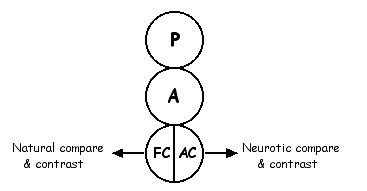
Compare-contrast dia

The two different types of compare and contrast could be seen as functions of separate aspects of the personality.

It is a Free Child function when people use compare and contrast (C & C) to get an understanding of self. When we meet our peers we can learn about ourselves by understanding how others think, feel and behave. When we meet those who are the same age, gender, occupation and so forth it gives us a reference point from which we can understand ourselves. By comparing and contrasting to our peers we gain a fuller understanding of who we are.

In addition to this when we meet others who are dissimilar we can also compare and contrast for the same purpose. In recent times I have travelled to countries like Serbia and Croatia and got to know people who are from a different culture. As I have gotten to know my new friends more I notice things about them that are different to how I and other Australians think, feel and behave. I have compared my self and my culture to them and their culture and thus I now have a fuller or more profound understanding about myself (and them).

Aliens

Whilst this seems fairly normal the process of compare and contrast can become excessive therefore resulting in neurotic behaviour which would be seen as an Adapted Child ego state function. In this case people could be seen to use C & C excessively or use it in a way which creates painful feelings and self destructive behaviour.

Consider the example above where two people were listening to the pianist and had two quite different reactions. The one who was consumed with envy used C & C when there was no FC reason to. It resulted in painful feelings for her which would very likely effect her behaviour to the pianist which is likely to be destructive to the relationship. This could be seen as an instance of neurotic compare and contrast. Why would she do this whilst the person sitting beside her does not.

There are a number of parenting scenarios that may lead to this in adult life

1. Parents rate people’s worth on what they have and who they are. The children being in the home see this and model on it. A person from the rich side of town may be spoken of in glowing and respectful ways by the parents. Those of limited means are seen to be less than by the parents. Children growing up around this type of thinking could develop neurotic C & C behaviour in adulthood.

Walking ladies

2. The parents compare children with their siblings or their peers. This may happen when parents place children in child beauty pageants. In such instances children are directly and openly being compared and contrasted to their peers. Indeed this happens in any competitive situation. If parents encourage this AND have the attitude that the winner is a better person or some how worth more then C & C may develop in the child’s mind.

If parents encourage children to use competitive pursuits to better them self and realise their potential then neurotic C & C would be less likely to develop. If winning and loosing get entangled with a sense of self worth in the child’s mind then neurotic C & C could develop it would seem.

In the example of the pianist the envious woman was not really concerned about the musical talent. The issue is that because her friend was a more talented that meant (at least in her mind) that she was a better person, more worthwhile, a more important or superior person than her.

3. Sometimes parents favour one child over another. For some reason they give one child more stuff, time, encouragement, love and so forth. This could develop are sense of comparison in the minds of both children, the favoured one and the non favoured one. They are raised in an environment where things are uneven and this signifies a different attitude and feelings in mother to each child. Thus the ‘things’ become important to the children because they represent affection or attention from mother and the value mother has of the child.

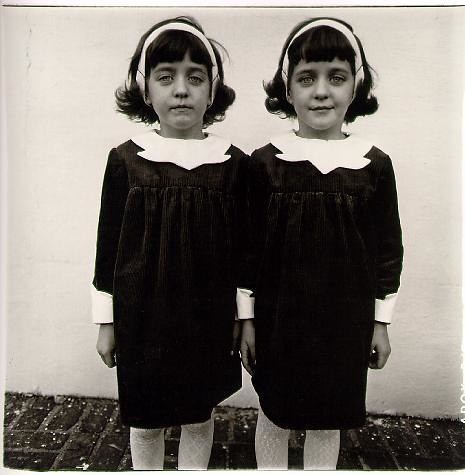
Blizanci

Indeed the same applies the other way. In some domestic situations one child will be singled out by mother or father for extra punitive treatment. For some reason in the psyche of mother one child will be treated more badly, punished more, discounted more and so forth. Again the child will notice the unevenness of this and that it is related to important factors in the psychology of mother.

4. Related to the above one could argue that younger siblings are more likely to develop neurotic C & C because they see the older one getting more stuff, freedoms and liberties. Generally speaking older siblings have more psychological impact on the younger siblings than the other way around. Older siblings are more important to the younger sibling than the other way around. Indeed not uncommonly an older sibling can have a significant impact on the development of transference templates of the younger sibling’s psyche. It is much less likely to occur the other way around.

Kid tongue

The younger sibling observes the older one get more ‘stuff’ and becomes envious. For instance the younger sibling has to go to bed at 8pm and the older sibling is allowed to stay up until 10pm. In its mind the age difference is insignificant and the older sibling is simply being favoured by mother and father. Hence C & C is more likely to develop in the mind of a younger sibling.

5. As presented elsewhere
when children develop in their early years they make decisions about what is called their life position. They decide on the value of self and others such as I’m OK, You’re OK (I+U+). There are seven different life positions they can choose from. One is the life position of I’m not OK, But you’re worse (I-U--). In this instance the person feels bad about self but sees others as worse thus making self feel better.

In this case the child has decided to use the process of C & C to protect its sense of self. In essence C & C process becomes a defence mechanism. They compare and contrast self to others perceived as ‘worse’, so as to defend self against its own anxiety generated by realising its own low self worth.

----------------

Feeling envy
These 5 examples show how some children are primed or programmed to enter adulthood and engage in the process of comparing and contrasting. Others who have not had such experiences will not be programmed in such a way. In adulthood they will not naturally compare themselves to others they meet.

The woman who was listening to the pianist and did not feel envy may simply have not compared herself to the pianist and thus she is not aware there is a difference. As our original definition stated, if one is not aware of a difference then one cannot feel envy.

Graffiti