Showing posts with label parenting. Show all posts

Sunday, December 29, 2013

Posters Volume 1.

In recent times (months) the format I have been writing in has changed. I have created a series of what I call information posters and been using them on my FaceBook. Over time these began to mount up so I began to collated them into volumes (three so far) which I have included here. I expect these to continue. Indeed I am in the middle of creating volume four right now.


See volume 1 here.

Graffiti

Wednesday, June 26, 2013

Racket feelings and manipulation


In my upcoming workshop on racket feelings I look at the role feelings can play in human relationships. Especially how people use feelings to manipulate each other. The three most common feelings used to manipulate others are fear, guilt and shame.

For example, many men and women have had a covert unwritten agreement for many generations. Most of the time they are unaware they are even doing so. Women have learnt that in conflict with a male if they start to cry some men will tend to give them what they want, at least to some degree. They are behaving in such a way that the man will feel guilt and this motivates him to change his behaviour in such a way that suits the woman.

Face..

On the other hand men have learnt that if they begin to raise their voice and show some level of anger then some women will have a fear response and this motivates her to change her behaviour such  that it suits the man to some degree.

Then there are parents and children. Parents learn quickly that to get a child to do what they want using fear, guilt or shame is much more effective than the usually prescribed methods of time out and consequences of behaviour. The only difficulty with using the feelings method of parenting is there are some negative side effects for the child.

Bendy

Graffiti

Sunday, March 10, 2013

International women's day


I am not sure if this will get me into trouble or not.

The other day was women's day and the local newspaper here did a big spread on a local woman called Fiona Wood. She has been Australian of the year and is a high profile woman. She runs a successful medical practice and business that develops new products like spray on skin for burns victims. She specializes in burns and was at the forefront when all the burns victims from the Bali bombing arrived in Australia. She is also the mother of five children.

Family on bike
With a young family it is often like this. 

The newspaper had a photograph of her hard at work and another photograph where she was surrounded by her five smiling children. The article was how she claimed she had been able to maintain a busy high powered work life and have five children where she could also meet their psychological needs over the years. She was putting herself out there as a woman who did this and being a model for all other women who wanted to do the same. 

In my view she does not help women in general and indeed perpetuates the problem. Most days I work I counsel women and their children. A common theme of what these mother’s present is guilt about what they have and have not done with their children along with their desire to fulfill their own work life aspirations. This can cause a great deal of angst for some women.

Fiona Wood claims she has been able to do both successfully and puts here self out there in public for other women to see. That is a big claim to make, that may or may not be true. I have had two children of my own and I know how much time it takes. I can recall making the decision when they were both very young that I would put the development of my career on hold as it would simply take me away from the children too much. I did not see how it was possible to have a very active career and be around the children enough to meet their psychological needs in relationship to a father. And I only had two children and I was the guy (not the mother)!

Knocked up nun

So the claims Fiona Wood makes are either not true or if they are true then she has very exceptional abilities at organization and being able to meet children’s psychological needs in a way which the vast majority of other people can not do, including me. Which ever one it is I do know that many of the mother’s I counsel are going to read the newspaper article and realize they cannot do what Fiona Wood claims she can. They are then going to feel guilt, bad about themselves, they can not do what others can do, they must not be trying hard enough, and so forth. Basically it is going to make them psychologically worse off.

It is well known the damage supermodels can do to the psyche of women. They are put out there in magazines with bodies that the vast majority of women can never have because they are not built that way.

Fiona Wood is the same. She is a kind of supermodel working mother that other women can aspire to. In my view the average woman can not ever achieve what Fiona Wood claims she and thus we have the same damage caused to the women’s psyche as the bodies of supermodels do. They are left feeling not as good as, or yet again a failure.

Graffiti

Saturday, January 12, 2013

Parenting the teenager who drinks alcohol


I was recently listening to the radio and heard an announcement about a new government initiative regarding drinking alcohol. The programme is called DrinkWise Australia. Part of it is about parents dealing with teenagers who drink. In my recent book - Working with drug and alcohol users - I discuss in depth the area of teenagers and alcohol and drug use. I decided to go to the website and have a look to see what they had to say.  

Jumper
The things teenagers do


This is basically what they say:

“3A Parents and carers should be advised that children under 15 years of age are at the greatest risk of harm from drinking and that for this age group, not drinking alcohol is especially important.

3B For young people aged 15–17 years the safest option is to delay the initiation of drinking for as long as possible.”

“Communicate your concerns about drinking alcohol to your teen. Discuss the range of risks involved and the impact on their physical, psychological and social health. They may not agree with your views on the matter but they need to understand why you have created the rules that exist in your home.

Involve your teenager in the development of the rules. As you and your partner decide on the rules and boundaries have your teenager with you. They may not like the rules but they are more likely to follow them if they understand your reasoning.

Renegotiate rules as they become dated – every six months. If you’ve created a set of rules around alcohol for a 15 year old, these need to be re-examined to suit different stages in your teen’s development.” (end quote)

Teenage bonding

In essence they are advising parents to tell their teenagers not to drink or at least have very restricted drinking.

In my book I note that there are two approaches here that parents can use.

1. To do what DrinkWise Australia suggests and recommend no alcohol use and possibly use punishments if they do not keep to those rules.

2. To not make any statements to the teenager about alcohol use being ‘bad’ and something you disapprove of. The parent does not tell the teenager not to drink. You simply listen to them talk about their drinking and make comments from time to time such as reflective listening or appreciating them being open with you.

The advantage to number 1 approach is it gives the teenager a clear sense of what is right and wrong which they will incorporate from the parents. The disadvantage of approach 2 is the teenager does not get the clear boundary set by the parents. 

The disadvantage to number 1 is you ‘loose’ the teenager in varying degrees. As soon as the teenager hears the parents say “don’t drink” it is likely from then on they will not get the truth about the drinking. The teenager who is drinking will either deny it completely or give the parents a significantly modified version that understates the amount they are drinking. Even if the parents deliver the ‘Don’t drink’ message in a soft form the teenager will still usually ‘hide’ their drinking at least to some degree.

This can be a problem as it can damage the relationship with the teenager in that they withdraw from the relationship with the parents. Hence they can experience more of a sense of isolation from the family. The teenager thinks, 

“I can’t tell my parents stuff as they will (disapprove, lecture me, worry about me....)”

If this is minor the negative effects are not so bad but if the teenager experiences it to a significant degree then it can be quite a problem.

Pick up girls

One thing you do not want is a teenager who feels isolated from the parents and family. The more a teenager has a sense of isolation the more psychologically vulnerable they are. This is why the most basic ‘rule’ of parenting a teenager is never break off the lines of communication. No matter how offensively they have behaved it is strongly advised that a parent never ceases communication with the teenager.

If they stop telling parents about their drinking, what else are they not telling the parents? If they stop talking with the parents about sensitive issues like drug and alcohol use that usually results in them giving more power and influence to the peers as they become the teenager’s main confidant rather than the parents. Obviously an undesirable situation.

As stated before approach 2 does not give the teenager a clear boundary set by the parents about drinking. However it is more likely to avoid the difficulties just mentioned which go along with approach 1. 

Approach 1 = directing from the front

Approach 2 = persuading from behind

Two women

In approach 2 the parents do not openly state that the teenager should not drink or take drugs. They simply listen to the teenager, reflect back to them and generally keep the teenager talking. As I said before the downside of this approach is that it gives implicit permission for the teenager to use alcohol but it does not have the negatives of damaging the relationship with the teenager that approach 1 can. Approach 2 tends to give the teenager a sense of a connection with the parents and the parents can become a key person who the teenager confides in. The parents can remain more influential in the teenager psyche for longer. This reduces the negative impact that can come from ‘advice’ given by peers. Also the teenager does not experience a sense of isolation which makes them more psychologically robust.

The parent would tend to be saying things like
That’s a good point
What do yo think would happen if you did this..?
It seems like that worries you

It’s more of a counselling approach to parenting but if at all possible the parent should avoid becoming a ‘therapist’ to the child. Unlike approach 1 which is a directive approach, approach 2 is persuading from behind. This is done by highlighting certain points and ignoring other points. It’s a much more subtle approach to the parenting of the teenager.

As so often happens when dealing with teenagers about alcohol use the parents are left with two bad choices. The goal is to choose the least bad one. Both approaches have positives and negatives.

Vader in Japan
Parents have all sorts of different appraoches to teenagers depending on their own personalities.


However as also is the case in parenting often the best approach to use ends up being dependent on the personality of the child and the parent. If the teenager tends to be somewhat conservative in their attitudes and somewhat conforming then approach 1 may be best. If one has a strong willed, rebellious teenager who is in a group who use alcohol and drugs then approach 2 may be the best choice. In these circumstances to use the approach suggested by DrinkWise Australia could result in some quite negative outcomes.

Graffiti

Monday, September 24, 2012

Developmental stages of adulthood


I am currently reading a book by Jay Haley about the work of Milton Erikson. It’s a summation of the work of Erikson. Haley was probably trained in psychoanalysis because in his writing there are a number of references to how it is not necessary look at the past, what a therapist deals with is what the client presents now. There is a flavor of rebellion against the psychoanalytic approach in this way.

This leaves one with a telling question: if you don’t go back to the past of the person what do you do? He suggests a short term, here and now approach that is family therapy oriented. 

However one thing I have discovered that was somewhat insightful for me, is one of the greats of family therapy - Milton H. Erikson - rarely saw the whole family together. What he did see was various family members alone or in various combinations separately.

This is what I have done over the years even though I never considered myself a true family therapist because I rarely saw the whole family together. Now I discover to do family therapy you do not actually have to see all the family together. In my book working with drug and alcohol users I spend significant time discussing therapy with the teenage drug user and this is exactly the approach I describe when I work with them. You see any person in the family who becomes relevant to the issue at hand and in any combination that is relevant.

Group therapy
Family therapy

In essence I am doing family therapy but I certainly diverge from Erikson and Haley in that I will and regularly do delve into the past and individual psychology of the various parties. However this ‘discovery’ has solved another problem for me as well.

Some counsellors have a rule that if you see a couple then you cannot see either party  in individual counselling. Or if you see an individual then you cannot also start seeing them and their partner for couples counselling. I (along with other therapists I may add)  have never adhered to this view but some can get quite hot under the collar about it all and start saying things like it is unethical and so forth.

Well know I have theoretical back up for it all. I am doing family therapy Milton H. Erikson style, which is true, I am.

Body dismorphia
Body dysmorphia


However I have digressed from the point at hand

When working with an adult client at some point I always ask myself the question -why now? Why has the client sought psychological help now and why not 5 years before or in 5 years time? If there has not been a specific event that has resulted in the client attending counselling why has the client appeared now? The answer to it can of course be related to developmental psychology. The person has reached a particular developmental stage in the human life cycle and it is causing difficulties for them.

Developmental psychology
There has been a huge amount written on this area with a prime example being Freud. This chart summaries Freud’s theory of the psychosexual genesis

Freuds Psychosexual Genesis 002

It shows the different developmental stages a child goes through and isolates the the developmental tasks it has to master. Most notably the oral, anal and phallic stages. Although the latency, eurethral and genital stages are added here most of the emphasis is on the pre latency stages. As a child goes through each of the stages they effect its personality development and the person becomes who they are. We all get fixed to some degree in the oral, anal and phallic stages.

The two charts below show what can happen if a person is fixated at the oral stage of development. It is divided into the oral sucking and oral biting stages. If unsuccessfully mastered the person can develop things like eating disorders or addictions especially an addiction to cigarettes.

Oral Stage 1

***

Oral Stage 2

In the second chart the top two rows relate to oral sucking and the bottom two rows relate to oral biting.

Whilst this is all good and well it only relates to childhood. In one way this is logical as it is during that stage that we develop the basis of our personalty. By adulthood most theories of child development agree that the personality is formed and in most instances after that time little extra change occurs.

However that does not mean there are not subsequent stages of development to master. Just like the child has to master the oral and anal stages of development the adult also has to successfully move through various stages. Thus we have the following equations

Childhood stages = master the stage and major impact on personality formation
Adulthood stages = master the stage and minor impact on personality formation

Throughout history these adult stages of development have been the poor cousin in developmental psychology. Not much has been said about them and they are by and large ignored or at least viewed as much less important than the childhood stages of development.

When adult stages have been discussed people often gravitate to the theories of Erik Erikson (No he wasn’t Milton’s brother!). A summary of Erik Erikson’s theory of development called the eight ages of man, is illustrated below

Eriksons 8 Ages 001

As one can see it covers the whole life span from birth until the end of life in old age.   The last three are the adulthood stages of development. He saw each stage as being a ‘battle’ between two possible outcomes. For instance in the stage he calls Adulthood he sees the goal for the individual to develop generativity versus a state of stagnation. 

In generativity the adult person seeks to establish and guide the next generation including things like productivity and creativity. He says in this way the mature person is dependent on the younger generation. The adult person needs to be needed and this need can be satisfied by guiding the young. If this is not achieved then the adult person will suffer a pervading sense of stagnation and personal impoverishment.

I find this a reasonably good statement but to me it lacks substance. It would be good for the adult person to become a guide and teacher for the young but is that it! Is that the one and only developmental task the adult person is meant to master? And from a therapeutic point of view, if one has a client who is 40 years old how is this idea of generativity vs stagnation meant to help. To me it is too esoteric in this way.

Army child

There needs to be more and by and large developmental psychology has failed in this way. Hence I arrive at Milton Erikson and Haley and what they developed. As mentioned before they refused to delve into the past unlike the majority of developmental psychology and therapeutic approaches. In my view this was a counter reaction away form the psychoanalytic philosophy of Freud.

I stated before, “if you don’t go back to the past of the person what do you do?”


As a result of this philosophy they were forced to construct a developmental theory of adulthood that was based on a behavioral understanding or focus. They developed a therapy that was short term solution focused, oriented primarily to behavioral change in how the family members related to each other.

This theory came from a clinical therapeutic basis, meaning it will tend to be readily applicable in the therapeutic setting unlike Erik Erikson’s theory. As this evolved out of their own experience with clients it meant it was their observations of a large number of clients. They were starting to identify where people tended to have problems as they moved through their adulthood. They were identifying the times (or stages) when adults had to master new tasks as a result of their increasing age.

Jealousy

But they kind of did it back to front. Instead of saying OK a child has to learn how to breast feed successfully whilst relating to mother, therefore the first developmental stage is the oral stage. If it does not successfully master this then the problems it will have are....

In this case they were identifying the developmental stage first which then subsequently led to the formulation of the problems relevant to that stage.

Instead Milton Erikson and Haley said, “I observe that children who present with problems seem to have difficulty leaving the parents and the home.”

In this instance first they identified the problem which subsequently led to the formulation of the developmental stage

In essence they came up with a developmental theory of adulthood by accident.


Adulthood developmental stages

The courtship period developmental task - establish a long term relationship with a mate.

Being a social person as an adult developmental task - establishing a social world external to the family of origin and some what external to the mate.

Getting married developmental task - make the decision to enter into a marriage type relationship.

Dealing with childbirth and young children developmental task - coping with and mastering the difficulties of raising young children

The middle years of marriage developmental task - between 5 to 15 years of marriage when divorce tends to happen due to the change in perception of marriage by one or both parties.

Parents letting children leave home developmental task - parents being able to wean self off children and let them move away.

Resolving the movement into old age developmental task - mastering coping with changes in the body and accepting death as a matter of course.

An interesting collection of stages that are directly applicable in counselling. If a 25 year old female presents with agoraphobia the question must be asked, “Is she successfully mastering the courtship stage developmental stage”? As I have said before sometimes it’s clear that family dynamics are involved and at other times they are just not relevant and then one moves to an individual past oriented approach to the counselling.

Graffiti

Saturday, June 23, 2012

Maternal over protection


Another way the Adult ego state can remain underdeveloped is due to what has historically been called maternal over protection. In Transactional Analysis terms the mother (or father) does not allow the child develop out of the symbiosis it formed at a very young age with mother. A new born has no Parent or Adult ego states and thus it has to form a symbiosis with mother and ‘use’ hers until it develops its own.

In some cases the mother or father will not permit the youngster to develop their own Parent and Adult ego states. Psychologists have indentified four main ways maternal over protection can occur.

Aquaman
Life can be dangerous sometimes. How many risks does one take or let children take?


1. Restriction of the child’s social world. The child is encouraged not to develop friends and out of family contacts. The child may be kept from going to school because he often gets ‘sick’. Indeed when a child develops a school phobia (and refuses to go to school) often that is due to emotional maneuvering by the mother in the back ground who does not want the child to go.
2. Excessive contact. This can be continuous companionship of mother and child, prolonged nursing care, excessive fondling, prolonged breast feeding, sleeping with mother long past infancy. Highlighting of a special connection or relationship between child and parent. This can even be mildly romanticized and thus one has the development of the oedipus complex and the electra complex.
3. Infantilization. The parent treats the child in the same manner it would a much younger child. This can be in feeding, dressing, bathing, washing, punishing. The mother may dress a 13 year old son or punish him by putting him to bed in the afternoon.
4. Maternal control. This can manifest as either over domination or overindulgence of the child by mother.

Child smoker

All of these pressure the child to stay childlike and not develop a competent Adult ego state. If a child cannot think for itself then it has to continue to rely on mother to think for it. Thus we have another reason why as an adult a person may find it difficult to stay in their Adult ego state and require Adult ego state strengthening exercises.

Graffiti


Friday, June 15, 2012

Strokes and racket development


Already mentioned has been the role of temperament in racket development and how the use of emotions in parenting can also effect the development of certain rackets.
However one of the more powerful ways of fostering a racket is with strokes. When a child displays a certain feeling how do the parents respond with their stroking patterns. Do the strokes they give foster the feeling being displayed or tend to hinder its development.
This is reasonably easy to ascertain. One simply recalls when they were young and how they observed the parents responding. See the chart below:

Strokes and rackets

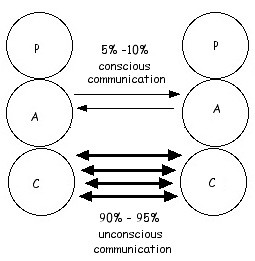
The patterns of stroking others does not stop in childhood but we are constantly being stroked in certain ways for the emotions we display. In many instances both parties are unaware of what is happening as it is unconscious communication. Indeed the vast majority of human communication is unconscious as this diagram shows.

Diagram 6

To ascertain these conscious and unconscious stroking patterns with those in your current life one simply changes a few questions. See the diagram below:

Strokes & rackets - 2

Of course this is a two way process. Whist you are being influenced by the stroking patterns of others you are also influencing them in exactly the same way. To gain some insight into this one can answer another series of questions:

Strokes & rackets - 3

Graffiti


Tuesday, February 28, 2012

Hurried child & personality types

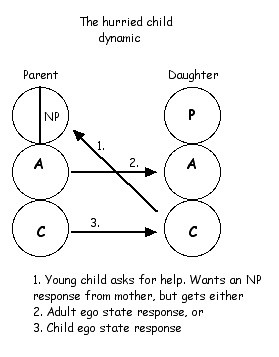
The hurried child syndrome is a common phenomena in society. The transactions involved in it are shown here.

Hurried child dynamic

A child falls over, cuts its knee and seeks out mother for assistance. The youngster asks for help in the first transaction. The child has two problems, first it has the physical problem of a cut knee that needs a bandage put on it. Second it has a psychological problem. It is experiencing pain, perhaps shock of the fall and then the sight of the blood and it is generally feeling distress.

To respond successfully to the request the parent must at some point respond from their Nurturing Parent ego state to solve the psychological problem and the Adult to solve the physical problem. The hurried child syndrome occurs mainly when the psychological problem is not dealt with. Some parents do not do this and this can occur in a variety of ways.

1. The parent simply not respond at all. The mother may be in bed suffering severe PND and is simply too depressed to respond. The mother may be alcohol or drug affected which also does not permit her to respond or there may be some kind of severe mental illness or she is simply so consumed with her own emotional torment that she cannot respond.

Woman
Body language of a competent parent?


2. Others may respond but only from the Adult ego state. The physical wound is tended in the proper way, but it is done is a purely problem solving way with no nurturing involved. The psychological problem is left unsolved.

This most often occurs in parents who do parenting by the book. They will have a manual or some kind of book on parenting. When a difficulty occurs they will seek out the manual to find out what the author says is the right way to respond to it. It typically has chapters on discipline, toiletting, use of a dummy or not, getting a child to sleep, eat and so forth. Good information to have indeed but it is only Adult ego state and may reflect an insecurity in the person about their parenting.

3. The parent responds from their own Child ego state. In this case the youngster will feel unsatisfied because the parental response is child like and has no competent grownup nurturing quality to it. The parent responds from their own Child ego state with some kind of magical thinking about how to treat a wound or may simply try and jolly the youngster in some child like way.

Hijab girl
Some parents are dominated by their own Child ego state


If there is no competent Nurturing Parent and Adult ego state response then the child is forced to hurry up and grow up emotionally. The most common reaction to this is one of anxiety. The child has a sense of being emotionally alone in the world and there is no big person around that they can emotionally rely on. There may also be some anger but the primary response is one of anxiety and scare.

Below is a list of personality types. The hurried child dynamic can occur in most of them but is more likely in a some than others. Obviously it will be more common in those that tend to be anxiety based personality types. This will include:

Obsessive/compulsive
Schizoid
Schizotypal
Avoidant


Personality type Adaptation

Paranoid The world is hostile so don’t trust anyone and deal with people by being angry and attacking

Schizoid The world is scary so withdraw from it (people) and don’t show any of your feelings

Schizotypal The world is scary so withdraw from it (people) and don’t think clearly by being a bit crazy

Antisocial You can’t trust anyone & life’s unfair so take advantage of people and do what you like

Borderline Relationships & life are very unreliable so frantically do anything to keep people around

Histrionic I must be the centre of attention so I will be dramatic, flirtatious and highly emotional

Narcissistic I have always been told that I am very important and the best so I will behave and feel like that

Avoidant Life is scary and rejecting so I will withdraw and feel worthless

Dependent I can’t cope with life and am worthless so I will cling to others and do what they tell me

Obsessive/compulsive I have to feel in control of life and myself so I will be orderly and perfectionistic

Graffiti

Tuesday, June 7, 2011

Anger in my personality

Anger work - How anger is structured in my personality


My Parent ego state and anger

When my father was angry he would (Hit, withdraw and sulk, shout, swear, give a lecture, get sarcastic, eat, fight, get depressed and so on)

Say -

Do -


When my Mother was angry she would:

Say -

Do -


girls small town

My Child ego state decisions about anger

When I was angry mother (father) would

Say -

Do -

Feel -

When I saw mother (father) angry I would

Say -

Do -

Feel -


What did your mother and father say about expressing anger. (OK, not OK, good, bad, time & place, men & women, etc)

Protest

As a teenager did you get rebellious and angry? If so how did you express it and how did the parent figures respond?

Summation of early decisions =


Graffiti